CATMIN III

In July this year UCL hosted the CATMIN III: Frontiers in Rydberg Physics conference, co-organised by groups from Innsbruck, Harvard and UCL. Topics included Rydberg atom qubits for quantum computers [1], precision measurements of QED and fundamental constants [2], Rydberg molecule studies [3] and field sensing [4]. Our whole group attended, including our undergraduate summer students Yizhen and Carolina.
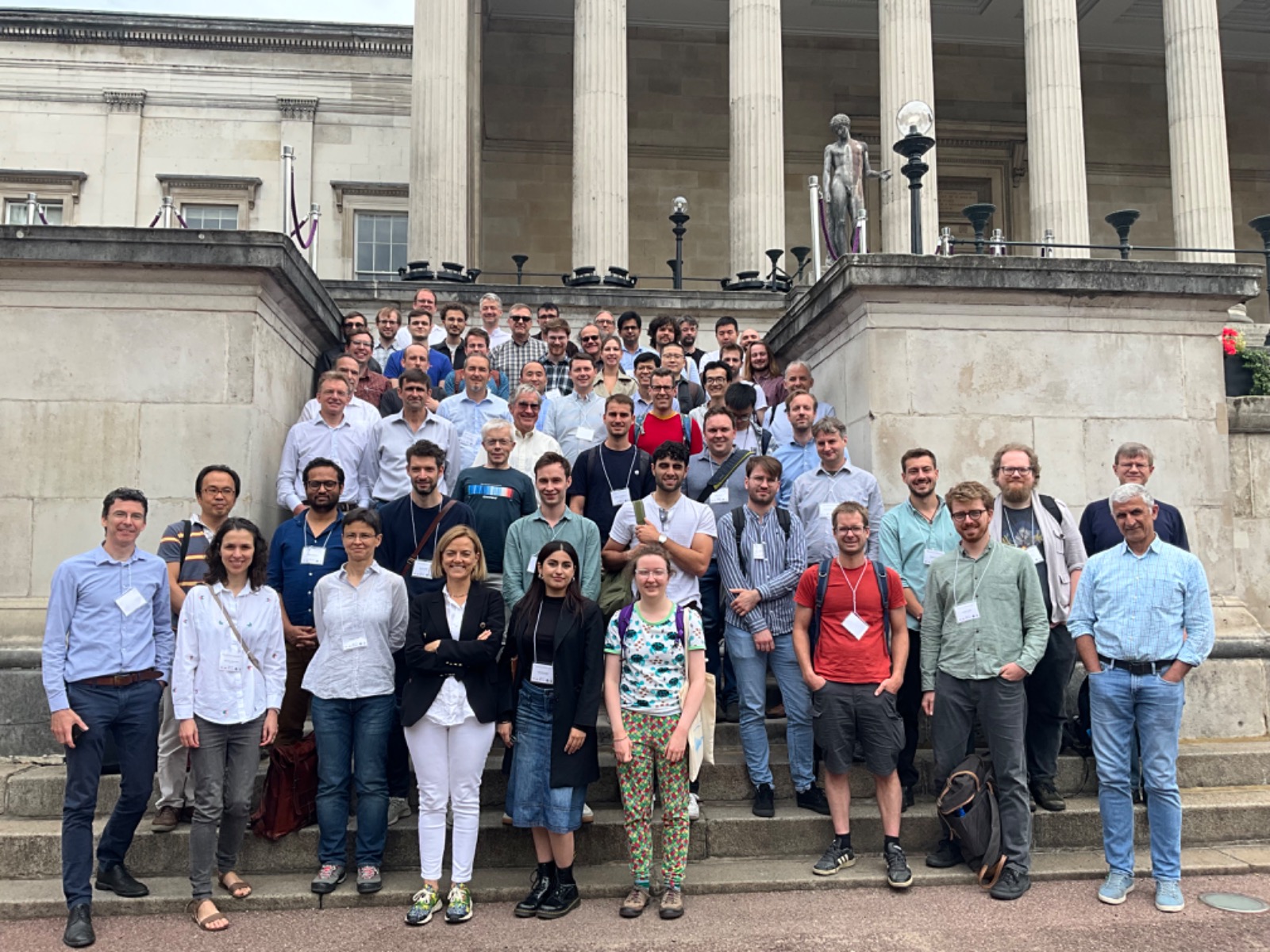
The group photo of CATMIN III in front of the UCL portico

David gave a broad presentation on Positronium Rydberg physics, including studies performed at UCL, most of which can be found on our publications page and a full video of the talk can be found on YouTube. Sam and I presented posters on ongoing work, both of which can be found in the downloads section. Sam is using Rydberg helium (He) to probe fields inside a microwave waveguide recently used to perform precision studies on the Ps n = 2 fine structure in which significant energy level shifts have been observed [5]. Given the sensitivity of Rydberg He to radio frequency, electric and magnetic fields and much better statistics compared to Ps we can investigate imperfections in the waveguide, a possible source of the shift found in Ps. A full blog post on this will be published soon.

My poster was on experiments done to observe THz (mm-wave) transitions in Rydberg Ps. For years the THz regime of the electromagnetic spectra (0.3 – 30 THz) was known as ‘the THz gap’, a band of EM radiation that is very hard to produce, lying between electronic methods at low photon energy and optical methods at high photon energy. However, much progress has been made in the last decade and there now exists commercially available technology (albeit for an extortionate price, a total of £90,000 for everything required) to generate radiation up to 1.7 THz. We are trying to measure the transition frequency between high n Rydberg states, in particular n = 21 – 24 which has a frequency of 0.874 THz. My poster described apparatus for this measurement but unfortunately, we have not yet seen any THz transition. We think the reason for this is that we have too little power (£90k only gets you 16 uW of THz power) or our statistics are too poor. Once this is working we can obtain a value for the Rydberg constant in a purely leptonic system which has advantages over the hadronic systems typically used (i.e. conventional atoms) [6]. This THz measurement can be done to examine systematics before an n = 2 – 21 measurement is performed for high precision result.

As well as the talks, we engaged in a different form of collaboration on Wednesday afternoon as there was a football match and a rounders game in Regents Park (we, of course, did very well… ish). After a somewhat achy Thursday there was a spectacular conference dinner at the Ambassador Hotel in Bloomsbury where the organiser of CATMIN IV gave a speech. We’d like to thank the organisers for hosting the event and allowing us to speak and look forward to CATMIN IV in Grenoble in the near future.

Sport!!
Rounders in Regents Park at CATMIN III

[1] Collectively Encoded Rydberg Qubit. N. L. R. Spong, Y. Jiao, O. D. W. Hughes, K. J. Weatherill, I. Lesanovsky, and C. S. Adams, Phys. Rev. Lett, 127, 063604 (2021)

[2] Precision millimetre-wave spectroscopy and calculation of the Stark manifolds in high Rydberg states of para-H2. N. Holsch, I. Doran, M. Beyer and F. Merkt, J. Mol. Spectroscopy, 387, 111648 (2022)

[3] Quantum-state-dependent decay rates of electrostatically trapped Rydberg NO molecules. M. H. Rayment and S. D. Hogan. Phys. Chem. Chem. Phys. 23 (34), 18806-18822 (2021)

[4] Rydberg-atom based radio-frequency electrometry using frequency modulation spectroscopy in room temperature vapor cells. S. Kumar, H. Fan, H. Kübler, A. J. Jahangiri, and J. P. Shaffer, Optics Express, 25(8), 8625-8637 (2017)

[5] Precision microwave spectroscopy of the positronium interval. R. E. Sheldon, T. J. Babij, S. H. Reeder, S. D. Hogan, and D. B. Cassidy, Phys. Rev. Lett. 131, 043001 (2023)

[6] Precision physics of simple atoms: QED tests, nuclear structure and fundamental constants. S. G. Karshenboim, Phys. Rep. 422, 1 (2005)

DAMOP 2023

One of the most vital parts of research is networking. Collaborations between groups and colleagues in your institution, your country and even across the globe make for a growing and productive scientific community. Attending conferences is a fantastic way to advertise your research and meet new people, and this year our summer of conferences began in America.

Hosted by the American Physical Society in June, Rebecca and Sam flew to Spokane Washington to attend the 54th Annual Meeting of the APS Division of Atomic, Molecular and Optical Physics (DAMOP), along with UCL colleagues Stephen, Matt and Luke. The team were greeted with a spectacular welcome reception! DAMOP is a meeting that boasts research from the entire AMO spectrum, from experimentalists and theorists alike, including Quantum optics, measurements of gravity, matter-wave interferometry, Rydberg field sensing and producing Bose-Einstein condensates in space – to name just a few. The meeting also welcomed ambassadors from industry to meet their customers and promote new products, fostering a unique opportunity for members of industry and academia to share ideas and solve new problems.

The DAMOP welcome reception as the attendees arrived.

Rebecca and Sam both presented posters during the week: 2 of the 8 presentations on positronium (Ps) among over a thousand contributions. Rebecca presented the first measurement of the fluorescence decay rate of 2 3PJ Ps. Measurements of the Ps decay processes are excellent tests of bound state QED theory and potential signposts to new physics with this measurement being a step toward using fluorescence decays as one of these tests. Varying amounts of 2 3PJ character were introduced to metastable 2 3S1 atoms by controlling the amount of Stark mixing present with well-defined electric fields and allowing the atoms to propagate for a fixed amount of time before quenching them in large electric fields. Introducing more Stark mixing resulted in less remaining population when quenched and detailed simulations of the experiment allowed for a 2 3PJ lifetime to be extracted. Sam introduced our new Rydberg field sensing apparatus using excited states of helium. Our Ps microwave campaign thus far has seen asymmetric line shapes, shifts from theory and differing results for opposing microwave propagation directions. We investigated the last of these further by probing the fields in the experimental apparatus. Highly excited (Rydberg) states are extremely susceptible to external electric and magnetic fields and make ideal sensors for the scrutiny of experimental equipment in-situ.


Our UCL colleagues and frequent collaborators Stephen, Matt and Luke were able to Join us and gave presentations on their work. Stephen, head of the AMOPP group at UCL, gave a poster on the recent measurements in his group on the resonant energy transfer between Rydberg helium and ammonia molecules at sub 100mK temperatures. Matt, a PhD student in Stephen’s group and former Master’s student with us, gave a talk on lifetime measurements of cold Rydberg nitric oxide molecules in an electrostatic trap. Luke, also a PhD student in Stephen’s group, gave a talk on enhanced state control and tunability at a Rydberg-atom superconducting circuit interface.

Sam, Rebecca, Luke and Matt exploring Spokane.

We’re privileged to see the great work of our colleagues, both at UCL and around the world, coming together in such a large meeting. We’re extremely grateful to APS for hosting and organising the meeting, and to the UCL Physics and Astronomy postgraduate conference fund for providing support to Rebecca and Sam – without which wouldn’t be able to attend. Stay tuned for more updates on our research and the other conferences we went to this summer!

International Conference on Precision Physics of Simple Atomic Systems

Back in May, three of the Ps Spectroscopy team had the pleasure of attending PSAS 2022, which took place at the University of Warsaw, Poland. The conference focuses on precision measurements of simple atomic and molecular systems, including the development of new experimental methods and refinement of the theoretical calculations and models.

Group photo of the PSAS’22 Participants

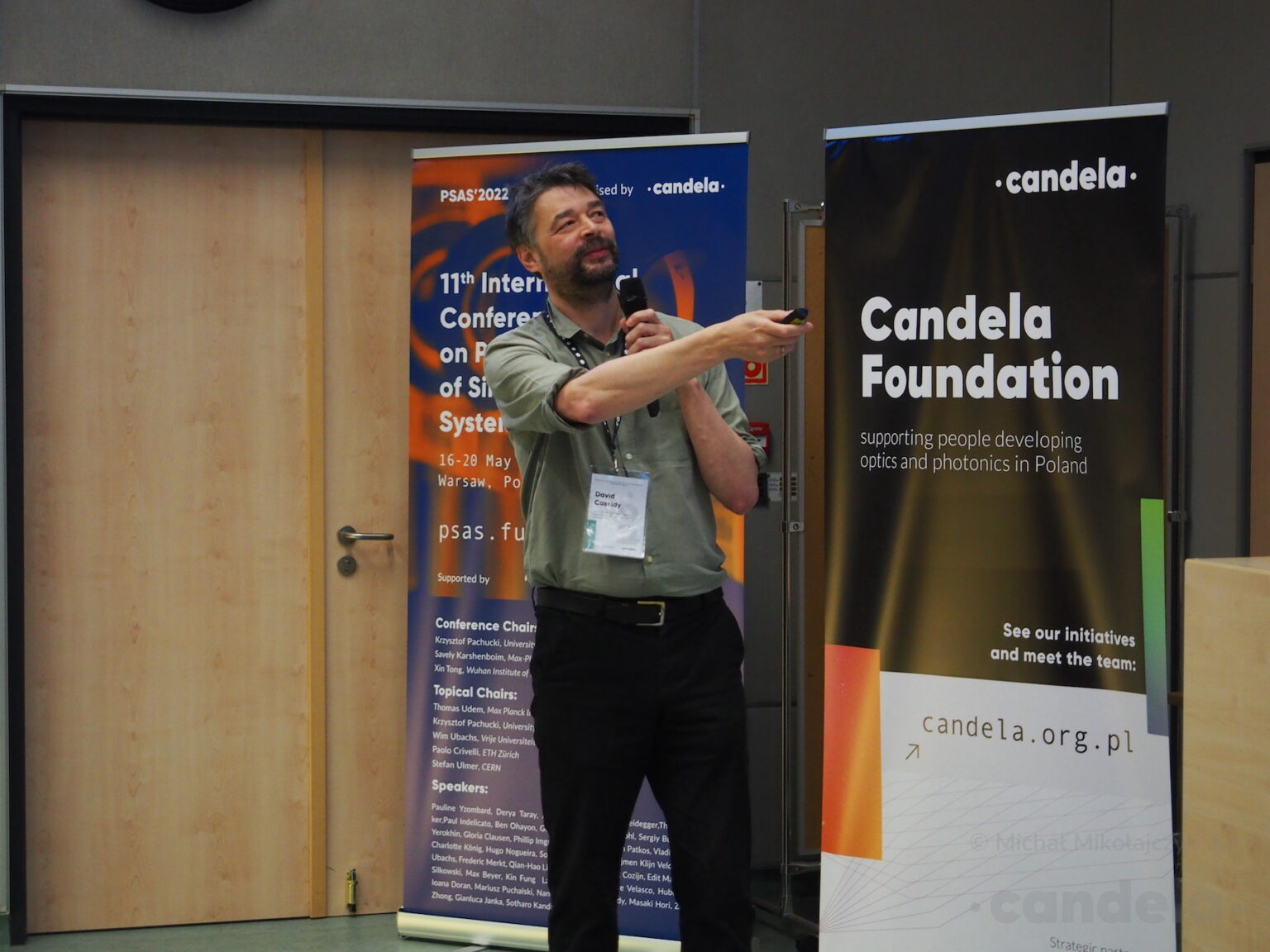
We heard talks from groups around the world, on Hydrogen, QED theory, exotic atoms and more. David’s talk was on our recent measurements of the microwave spectroscopy of the Ps n=2 fine structure. These experiments had the highest precision to date, though they significantly disagreed with theory and produced asymmetric lineshapes (published here and here). Later, we found out that the experimental vacuum chamber was causing reflections of the microwave fields, which appear to be the cause of the observed asymmetric lineshapes and shifts (published here).  Recent experiments with a smaller vacuum chamber initially seem to have reduced the reflections in the chamber leading to symmetric lineshapes, more info to come. All of the talks are available on YouTube and are well worth a watch.

David giving his talk

Tamara and Sam both presented posters on upcoming experiments, Ramsey interferometry of Ps and THz spectroscopy of He respectively. Tamara’s poster detailed our new DC Ps beamline (now in development!) in which an energy tunable 2S Ps beam will be created via collisions with Xe gas. With this we’re aiming to perform Ramsey interferometry using two waveguides instead of one, which we anticipate will improve our microwave spectroscopy measurements greatly. Sam’s poster showed some preliminary data on the THz spectroscopy of Rydberg He atoms. We’re planning to do more measurements like this in well-defined electric fields to perform the spectroscopy between stark manifolds, but more on all of these experiments is to come.

Sam presenting his poster

We’d like to thank the Candela foundation and the faculty of Physics at the university of Warsaw for organizing the conference and hosting us. We’re looking forward to the next PSAS in Wuhan!

Rydberg excitation in thermal Rydberg gases

This week we welcomed Dr. Weibin Li from the University of Nottingham who spoke about “Rydberg excitation in thermal Rydberg gases”. The abstract for this AMOPP seminar can be found below.

Rydberg excitation in thermal Rydberg gases

The creation of optical nonlinearities in atomic gases become a challenging task with increasing temperature, due to large Doppler effects. We study single photon excitation of electronically high-lying Rydberg states by nanosecond laser pulses that propagate in a high density thermal gas of alkali atoms. Fast Rabi flopping and strong Rydberg atom interactions, both in the order of GHz, overcome Doppler effects and dephasing due to thermal collisions between Rydberg electrons and surrounding atoms. The latter has not been taken into account appropriately so far. We show that a sizable dispersive nonlinearity is generated by strong interactions between Rydberg atoms. Despite the Rydberg optical nonlinearity, solitary propagation, i.e., self-induced transparency (SIT), of the light pulse can still occur. The existence of SIT allows to implement a conditional optical phase gate in the thermal gas through harvesting strong interactions. Our study paves the route to study nonlinear optics in thermal Rydberg gases and directly contributes to the current effort in realising scalable quantum information and communication devices with glass cell technologies.

Optimal quantum control with poor statistics

For this weeks AMOPP seminar, we welcomed Dr. Florian Mintert from Imperial College London who talked about “Optimal quantum control with poor statistics”. He argued the case for Bayesian optimization method to examine experimental data. The abstract can be read below.

Optimal quantum control with poor statistics

Learning how to control a quantum system based on experimental data can help us to exceed the limitations imposed by theoretical modeling. Due to the intrinsic probabilistic nature of quantum mechanics, it is fundamentally necessary to repeat measurements on individual quantum systems many times in order to estimate the expectation value of an observable with good accuracy. Control algorithms requiring accurate data can thus imply an experimental effort that negates the benefits of avoiding theoretic modelling. We present a control algorithm based on Bayesian optimisation that finds optimal control solutions in the presence of large measurement shot noise and even in the limit of single shot measurements. With the explicit example of the preparation of a GHZ state, we demonstrate in numerical simulations that this method is capable of finding excellent control solutions with minimal experimental effort.

Using the Zeeman effect to manipulate radicals and study ion-radical reactions

This weeks AMOPP seminar was given by Dr. Brianna Heazlewood from the University of Oxford. In this interesting lecture, Dr. Heazlewood spoke about “Using the Zeeman effect to manipulate radicals and study ion-radical reactions”. The abstract for the talk can be found below.

Using the Zeeman effect to manipulate radicals and study ion-radical reactions

In spite of their real-world importance, very few experimental methods can be applied to the precise study of gas-phase ion-radical reaction systems. This is primarily due to the significant difficulty associated with generating a pure beam of atomic or molecular gas-phase radicals with tuneable properties. In this seminar, I will present our work in generating a pure beam of velocity-selected radicals. Only the target radicals are transmitted into the detection region; all other components of the incoming beam (radical species travelling faster/slower than the target velocity. precursor molecules and seed gases) are removed. This control over the properties of the radical beam is achieved through the use of a magnetic guide, composed of four Halbach arrays (permanent magnets in a hexapolar configuration) and two skimming blades. Experimental measurements of Zeeman-decelerated H atoms transmitted through the guide, combined with extensive simulations, show that the magnetic guide removes 99% of H atoms travelling outside the narrow target velocity range [1,2]. We will shortly combined the Zeeman decelerator and magnetic guide with an ion trap, for the study of ion-radical reactions. I will present some recent work on the reaction of ions with polar molecules – and discuss how we intend to adapt this approach for the study of ion-radical processes.

[1] J. Toscano, C. J. Rennick, T. P. Softley and B. R. Heazlewood, J. Chem. Phys. 149, 174201, (2018).
[2] J. Toscano, M. Hejduk, H. G. McGhee and B. R. Heazlewood, Rev. Sci. Instrum. 90, 033201, (2019).

Precursor of the Higgs Mode in Ultracold Few-Fermion systems

This week we had the pleasure of welcoming Dr. Philipp Preiss from the University of Heidelberg who gave a talk on “Precursor of the Higgs Mode in Ultracold Few-Fermion Systems”. The abstract can be read below.

Precursor of the Higgs Mode in Ultracold Few-Fermion Systems

The emergence of collective modes from single-particle excitations is one of the most striking features of strongly interacting systems. Understanding such excitations is an ongoing challenge in nuclear physics, strongly correlated electron systems, and high-energy physics. Ultracold atoms in optical potentials provide a unique setting to precisely study the appearance of collective excitations in a tunable laboratory setting.

Here we experimentally observe the “birth” of a collective mode in a few-body system of ultracold Fermions. Using optical tweezers, we deterministically prepare few Fermions in the ground state of a two dimensional trap. This system exhibits a shell structure of stable “magic” numbers of 2,6,12… particles. We perform many-body spectroscopy through a modulation of the interaction strength find both single-particle and two-particle excitations. The latter consists of pairwise excitations akin to Cooper pairs and can be identified as the precursor of the Higgs mode in a two-dimensional Fermi gas.

In the future, we will probe such mesoscopic Fermi systems with single-particle detection. We recently demonstrated spin-resolved fluorescence imaging of individual atoms in free space, which will allow us to detect the momenta of every particle in the system in time-of-flight. We expect to directly see the formation of Cooper pairs and the momentum space signature of the BEC-BCS crossover.

Trapping long-lived Rydberg states of nitric oxide

The first talk in this year’s series of AMOPP seminars was given by Dr. Adam Deller from Prof. Hogan’s group in UCL. Adam, who was one of the first members in the UCL Ps spectroscopy group, talked about miniaturised Rydberg-Stark decelerators used to trap nitric oxide molecules. Abstract below.

Trapping long-lived hydrogenic Rydberg states of nitric oxide

High Rydberg states of atoms or molecules can have extremely large static electric dipole moments, upon which an inhomogeneous electric field will exert a sizable force. Electrostatic or time-varying electric fields have been utilised to exploit this effect to guide or decelerate and trap H, He, Ps and also H2.

I will describe a compact chip-based Rydberg-Stark decelerator comprised of a linear array of 115 electrodes. And I will present the results of recent experiments in which this device was employed to decelerate and trap laser excited NO molecules. An average lifetime of approximately 300 us was measured for molecules in the cryogenic trap. These cold, trapped NO molecules are of interest for studying low-temperature inelastic scattering processes for which long-range interaction play an important role.


SLOPOS-15

The Ps Spectroscopy team had the delight of attending the 15th International Workshop on Slow Positron Beam Techniques and Applications (SLOPOS-15) in Prague on 2nd-6th September, 2019. The workshop was held in the Faculty of Mathematics and Physics, Charles University in the centre of the Lesser Town square.

group

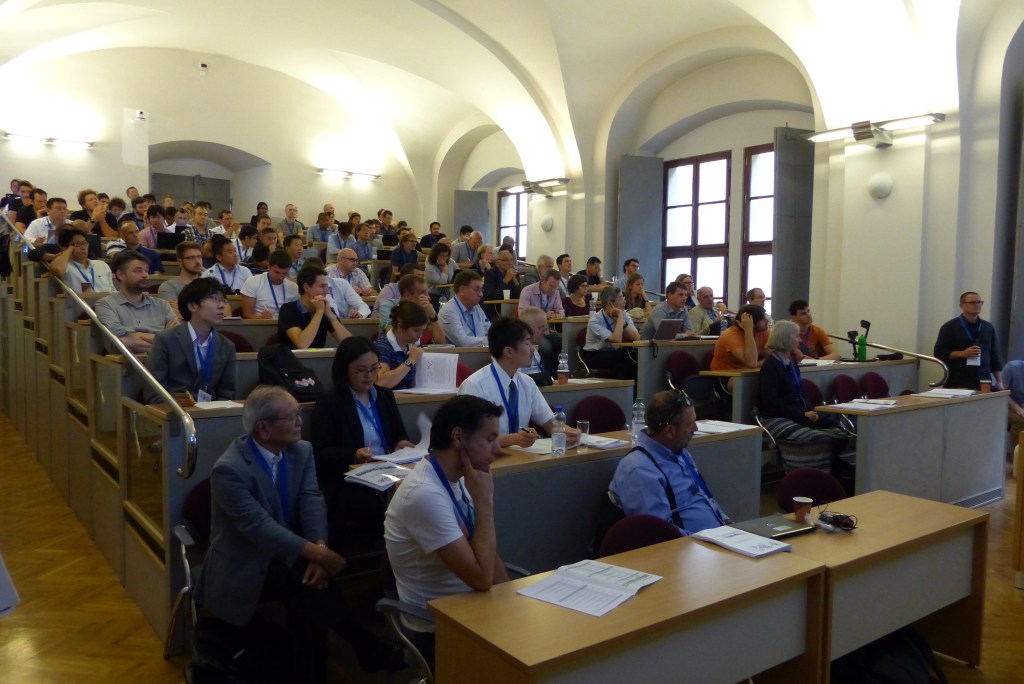
A wide range of topics, from Ps physics to defect studies, were discussed by over 100 participants in the workshop. David outlined the recent experimental progress in Ps-laser physics in his talk, while Ross talked about the versatility of a multi-ring guide for possible Ps deceleration and trapping studies. Lokesh presented the results of the new precision microwave spectroscopy experiment (stay tuned for more details). The complete list of abstracts can be found here. It was a pleasure discussing the ongoing work in the field of slow positron physics in the wonderful city of Prague.

We’d like to thank the local organising committee, led by Jakub Cizek, for organising an excellent meeting and we look forward to the next SLOPOS which will be held in Orléans, France in 2022.

POSMOL 2019

The Ps spectroscopy team recently attended the XX International Workshop on Low-Energy Positron and Positronium Physics and XXI International Symposium on Electron-Molecule Collisions and Swarms i.e. POSMOL-2019. The conference was organised by the Serbian Academy of Sciences and Arts (SASA) in Belgrade on 18-20th July.

POSMOL20191

Our most recent work on the microwave spectroscopy of Ps n=2 fine structure (more on this in the next blog post) was presented by Lokesh. It was a great opportunity to discuss our research with the positron (positronium) and the electron community as well as explore ongoing and future research from other groups. The complete list of abstract is available here, as well as the photo gallery.

We’d like to thank the organisers for planning this excellent conference and we look forward to the next meeting. The UCL Ps Spectroscopy group will be attending SLOPOS-15 in Prague in September. See you then!