Blog

Positronium Spectroscopy, Conference season!

The UCL Positronium Spectroscopy group has recently attended the final EU Marie Curie COHERENCE conference, iCoRD (International Conference on Rydbergs at Durham), where we presented our latest Rydberg Positronium results (PRL. 115, 173001). These results will also be presented at the 29th International Conference on Photonic, Electronic, and Atomic Collisions (ICPEAC) in Toledo, Spain.

We are now attending the 18th International Workshop on Low-Energy Positron and Positronium Physics & the 19th International Symposium on Electron-Molecule Collisions and Swarms (POSMOL) in Lisbon, Portugal, where we will also be presenting our Positronium time-of-flight spectroscopy (NJP. 17, 043059) results, as well as some of our latest results on Positronium at cryogenic temperatures.

The posters giving a brief overview of the contents in each 3 of these sets of results can be found in our Downloads page:

New Nd:YAG laser

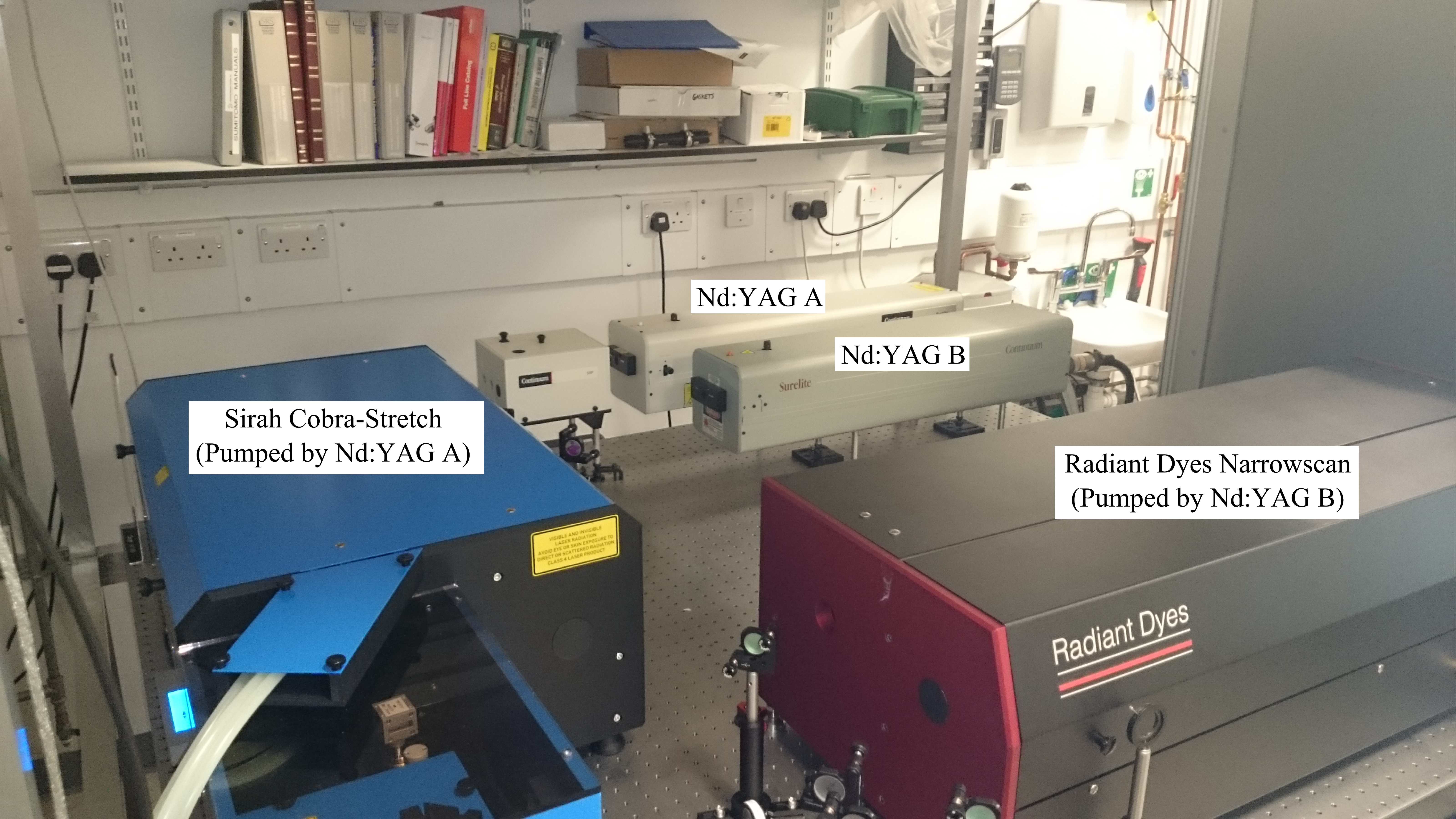
We have a “new” (used) Nd:YAG pulsed laser (labelled Nd:YAG B in the photo below) that can produce up to 600 mJ of 1064 nm light in 6 ns pulses which we frequency double to 532 nm to pump our Radiant Dyes Narrowscan laser.  The dye laser has a high-power, narrow bandwidth (5 GHz), near infra-red (730-750 nm) output.

As before, the 1064nm output of the “old” Nd:YAG (labelled as Nd:YAG A) is doubled to 532 nm and the sum-frequency of the first and second harmonic is used to generate 170 mJ of 355 nm light. This third harmonic pumps the Sirah Cobra-Stretch laser (another dye laser), which outputs broadband (85 GHz) 486 nm pulses that are then doubled to 243 nm (UV).

The 243 nm UV photons can resonantly excite ground-state Positronium into the 2P state; the excited atoms can then be driven to high-n Rydberg states with our infra-red laser (see Ref 1).

YAGB

The laser systems (A and B) are completely independent, so we can easily fine-tune the timing of the two and optimise the two-step excitation process.

Refs:

[1] Selective Production of Rydberg-Stark States of Positronium. T. E. Wall, A. M. Alonso, B. S. Cooper, A. Deller, S. D. Hogan, and D. B. Cassidy, Phys. Rev. Lett. 114, 173001 (2015) DOI:10.1103/PhysRevLett.114.173001.

What happens to a silica film at cryogenic temperatures?

Since we are interested in making positronium atoms we are always looking to shoot positron beams at various materials, and under different conditions. In some cases we might need our Ps atoms to be made in a cold environment, so they can be excited to Rydberg states without being harassed by black body radiation. One of the best positronium formation targets we have used are porous silica films, which we get from collaborators in Paris (Laszlo Liskay and co-workers from CEA Saclay) [1]. Because of the way these materials make Ps they are not very sensitive to the temperature, so it should be possible to cool them down without changing the amount or character of Ps produced after a positron beam is implanted. This has already been seen at around 50 K [2] but we decided to have a look for ourselves at a slightly lower temperature (12K) to see if the impact of the positron beam might cause some damage at these temperatures (it can happen [3]).

With a cold head installed in our new positronium interaction chamber, we have cooled one of Lazslo’s silica films [1] to 12 Kelvin (~261˚C) which is about 100˚C colder than the dark side of the moon. It turns out that our positron beam didn’t do any damage at all and the sample was basically fine, so just for fun we decided to blast it with a laser beam (UV light, at 243 nm).

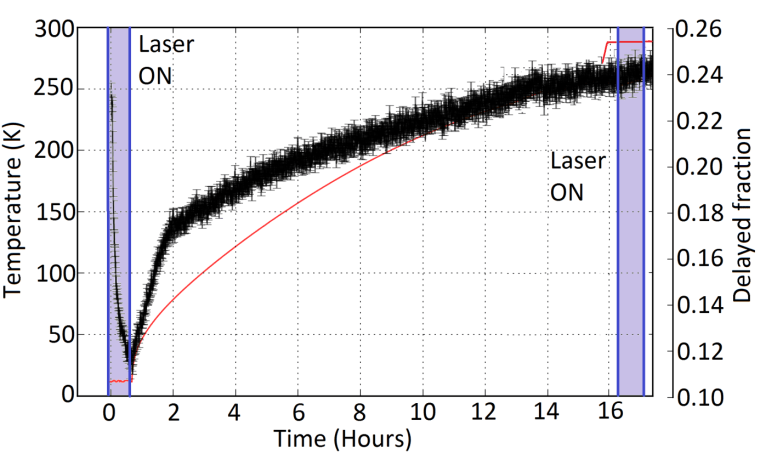
When you cool something down any gas in the region will tend to freeze on it. In ultra-high vacuum there isn’t that much gas around, but there is always a bit (known as residual gas, for obvious reasons) and after a while we do observe some fairly minor effects from all this freezing gas. Fortunately this takes a long time, and the sample is still useable for a week or so, and if you warm it up it will be restored to its original condition (since the frozen gas just evaporates away from the target). Once you start shooting the silica with a laser, however, things are not so stable, as shown in the figure. We observe a drastic reduction in the positronium formation efficiency after the silica is irradiated at low temperature (nothing happens at room temperature).

cryogenicPS

The delayed fraction f (black data points) measured for different sample temperatures (solid red lines), with the UV laser fired during the times indicated. Since f measures the amount of long-lived Ps present (it is more or less proportional to the fraction of incident positrons that form positronium) the sharp drop indicates that either less Ps is being created, or that it is being destroyed shortly after creation. The latter process is consistent with the experiment of Saito et al. Note that there is no effect from the laser at room temperature, and that the paramagnetic centers created at low temperature can be annealed out when the temperature is raised.

This is not very surprising, researchers in Japan already saw this many years ago [4]. Although they did not use lasers, and their experiments were done with slightly different samples (not thin films as we have been using) the physical mechanism is expected to be essentially the same. At low temperatures disturbed molecules are not able to repair themselves and so if they are distorted in some way by radiation they tend to remain in that configuration. This can create something called a paramagnetic center which is bad news for positronium atoms. Why? Well paramagnetic centers are essentially unpaired spins, and interactions with these makes it very easy for a long-lived (triplet) Ps state to be converted into a short-lived (singlet) state. In other words, paramagnetic centers kill positronium atoms. These killer centers are not stable at room temperature, and molecular thermal fluctuations can restore the system to its normal state (which generally does not contain any paramagnetic centers). This means that after we create these troublesome centers with a laser all we have to do to get rid of them is to warm the target up. When we do this (see figure above) we get an annealing/recovery process quite similar to the results of Saito et al [4].

Refs.

[1] L. Liszkay, C. Corbel, P. Perez, P. Desgardin, M.-F. Barthe, T. Ohdaira, R. Suzuki, P. Crivelli, U. Gendotti, A. Rubbia, M. Etienne, and A. Walcarius (2008). Positronium reemission yield from mesostructured silica films. Applied Physics Letters 92, 063114. http://dx.doi.org/10.1063/1.2844888.

[2] Paolo Crivelli, Ulisse Gendotti, André Rubbia, Laszlo Liszkay, Patrice Perez, and Catherine Corbel (2010). Measurement of the orthopositronium confinement energy in mesoporous thin films. Physical Review A 81, 052703. http://dx.doi.org/10.1103/PhysRevA.81.052703.

[3] D. B. Cassidy and A. P. Mills Jr (2007). Radiation damage in a-SiO2 exposed to intense positron pulses. Nuclear instruments and Methods B, 262 59. http://doi.org/10.1016/j.nimb.2007.04.220.

[4] Saito, Haruo and Nagashima, Yasuyuki and Hyodo, Toshio and Chang, Tianbao (1995). Detection of paramagnetic centers on amorphous- SiO2 grain surfaces using positronium. Phys. Rev. B 52 R689(R). http://dx.doi.org/10.1103/PhysRevB.52.R689.

System modification for Rydberg Ps imaging

A key milestone along the road to Ps gravity measurements is control of the motion of  long-lived states of positronium. Using methods previously developed for atoms and molecules we aim to manipulate low-field seeking Stark states within the Rydberg-Stark manifold (see below) using inhomogeneous electric fields [1, 2].

n11Dfrac

The force exerted on Rydberg atoms due to their electric dipole moment can be described as:

where n is the principal quantum number, k is the parabolic quantum number (ranging from –(n-1-|m|) to n-1-|m| in steps of 2), and F is the electric field strength [3, 4]. The figure above shows an example of Rydberg-Stark state manifold for n=11.

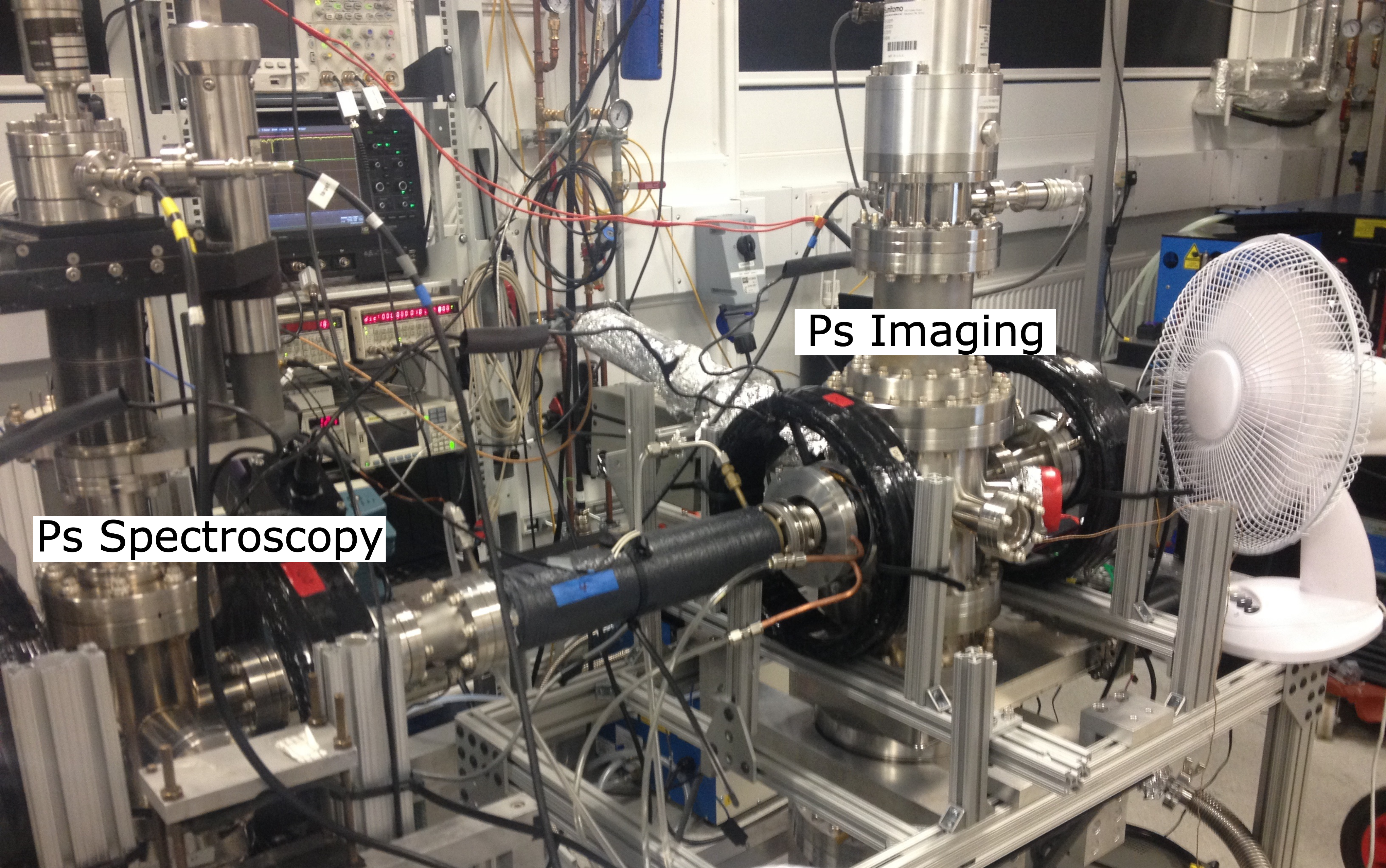
We have recently modified our experimental system to accommodate an MCP for imaging Ps atoms. This involved the extension of our beamline with another multi-port vacuum chamber, within which we should be able to reproduce laser excitation of Ps to Rydberg states.  These will be formed at the centre of the chamber and directed along a 45 degree path towards the MCP. If imaging Ps* proves successful we will then use electrodes to create the inhomogeneous electric fields needed to manipulate their flight path.

The addition of the new vacuum chamber to our beamline is shown below.

newchamber

Refs.

[1] S. D. Hogan and F. Merkt (2008). Demonstration of Three-Dimensional Electrostatic Trapping of State-Selected Rydberg Atoms. Physical Review Letters, 100:043001.                http://dx.doi.org/10.1103/PhysRevLett.100.043001.

[2] E. Vliegen, P. A. Limacher and F. Merkt (2006). Measurement of the three-dimensional velocity distribution of Stark-decelerated Rydberg atoms. European Journal of Physics D, 40:73-80.  http://dx.doi.org/10.1140/epjd/e2006-00095-1.

[3] E. Vliegen and F. Merkt (2006). Normal-Incidence Electrostatic Rydberg Atom Mirror. Physical Review Letters, 97:033002. http://dx.doi.org/10.1103/PhysRevLett.97.033002.

[4] S. D. Hogan (2012). Cold atoms and molecules by Zeeman deceleration and Rydberg-Stark deceleration, Habilitation Thesis. Laboratory of Physical Chemistry, ETH Zurich. https://www.ucl.ac.uk/phys/amopp/people/stephen_hogan/publications.

Positrons are cool (thanks to tetrafluoromethane)

The positronium spectroscopy experiments we perform are contingent on our ability to form and bunch dense clouds of positrons (anti-electrons).  These are implanted into porous silica where they pair up with electrons and form our favourite exotic element, Ps (which we then photo-ionise with lasers before the two components have chance to annihilate one another).

It’s been 24 years since the first buffer-gas trap [1] was used to collect positrons using a combination of electric and magnetic fields in a configuration known generically as a Penning trap.  The positron accumulation device is often termed a ‘Surko Trap’ after its inventor Cliff Surko, and there’s detailed information about how they work on his site.

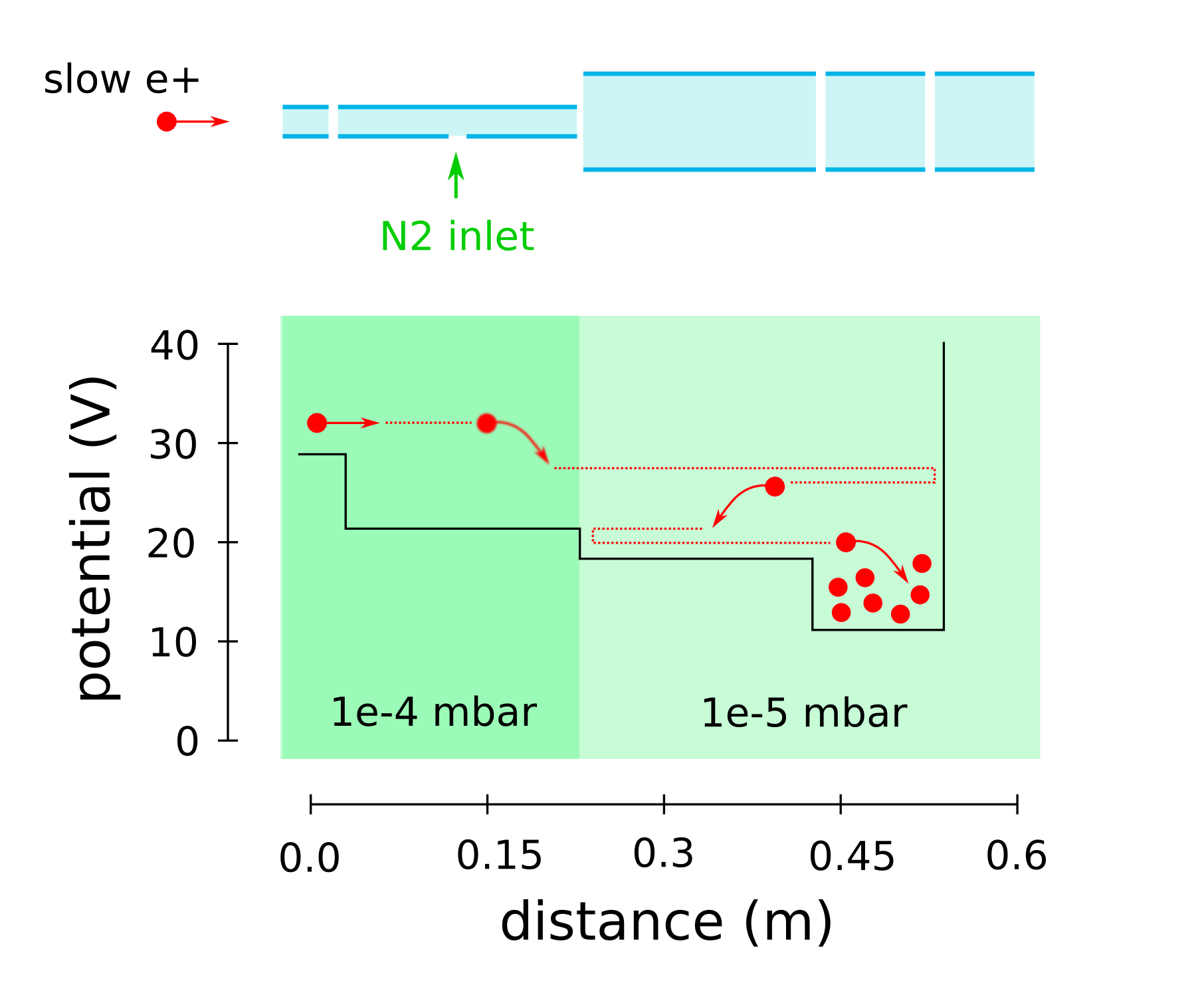
The magnetic field lines of a solenoid guide a low-energy positron beam through a series of cylindrical electrodes that have been biased with voltages to create an electric potential minimum (along the axis of the magnetic field) –  see figure below.  These fields alone are not enough to capture positrons from the beam, as those particles with enough energy to enter the trap can also escape it.  Admitting a small amount of nitrogen into the vacuum chamber allows positrons to lose energy as they traverse the trap via inelastic collisions with the buffer-gas molecules, resulting in confinement.  Unfortunately positrons are also lost to annihilation with electrons in the gas.  Surko traps feature several sections with the pressure in each optimised to either capture (higher pressure: good chance of an inelastic collision) or to keep (lower pressure: less chance of annihilation) positrons, which gives the trap its characteristic asymmetric shape.  Thanks to years of optimisation and refinements [2] these devices can accumulate hundreds of millions of positrons from a small radioactive source in just a few minuets (our fairly small trap is capable of capturing roughly half a million e+ in 1 s).  Pulsing the electrode voltages ejects the positrons from the trap in a dense, time-focussed (<10 ns) cloud that’s ideal for creating Ps atoms.
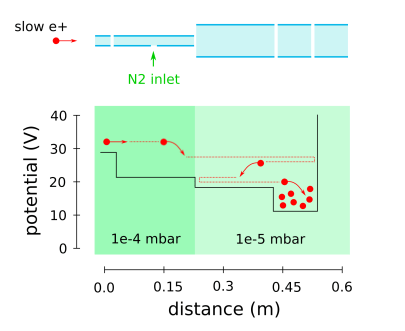
The details of how the positrons interact with the nitrogen are critical for optimisation of the trap.  The likelihood that a positron will have a collision with a nitrogen molecule is related to the pressure of the gas and the scattering cross-section: a hypothetical area that describes the apparent “size” of the molecule.   The scattering cross-section has numerous components that correspond to different types of interaction (elastic collisions, various types of inelastic collisions, ionisation, direct annihilation, Ps formation, …. etc) with some interactions more likely than others.  However, these cross-sections can vary significantly depending on the energy of the collision.

Nitrogen is used in Surko traps because there is a small range of energies  (around 10 eV) where inelastic scattering by exciting an electronic transition in the molecule is reasonably probable, compared to annihilation.  After the positrons cool below the energy needed to excite the electronic transition, further cooling relies on exciting the vibrational states of the molecule, for which the cross-section is rather small.  To speed up cooling we use a second gas, tetrafluoromethane (CF4), which has a much larger cross-section for low-energy inelastic collisions with positrons [3].

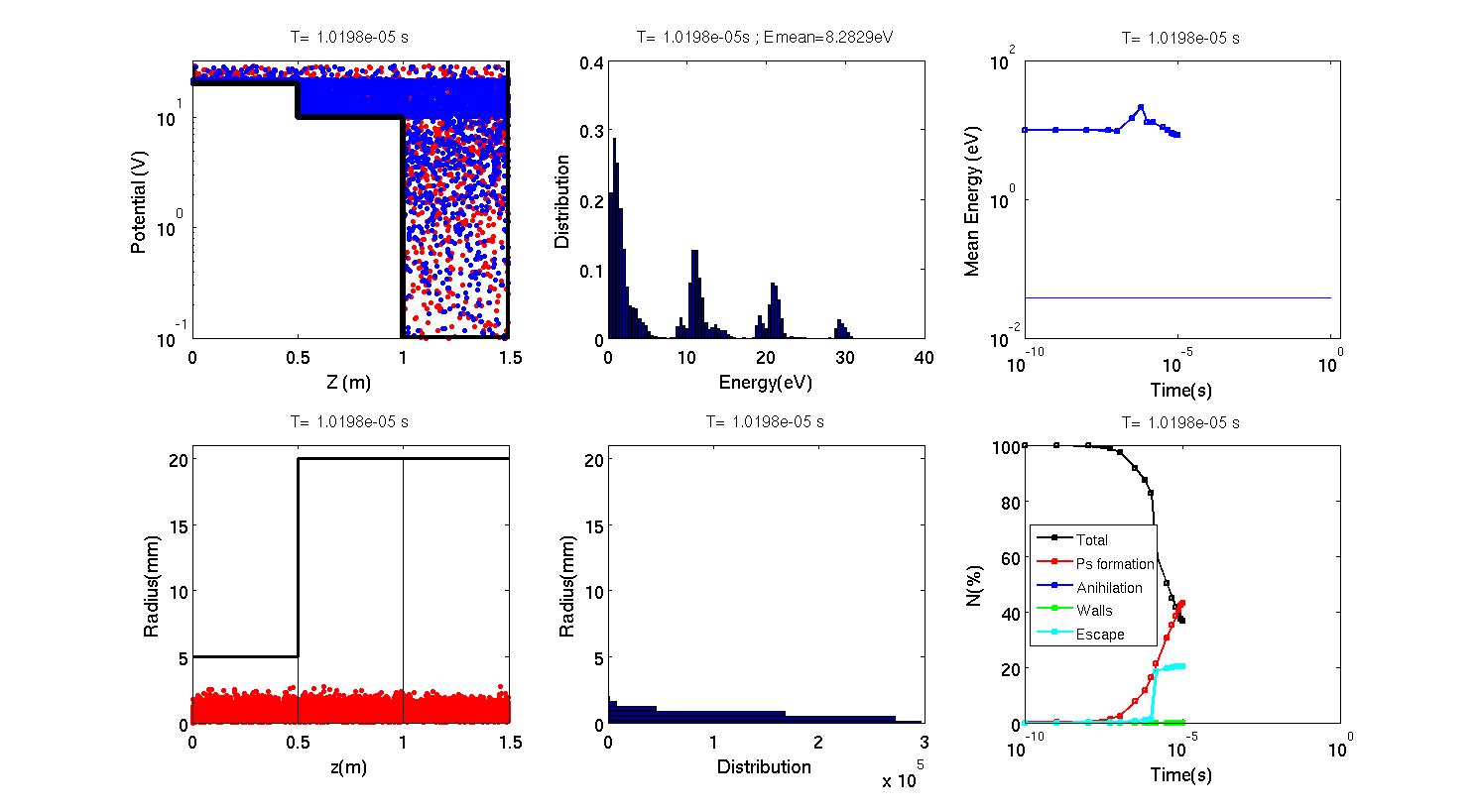
Recent Monte Carlo simulations of Surko traps offer a way to further optimise and improve trap designs without the need to manufacture dozens of prototypes.

benc_15

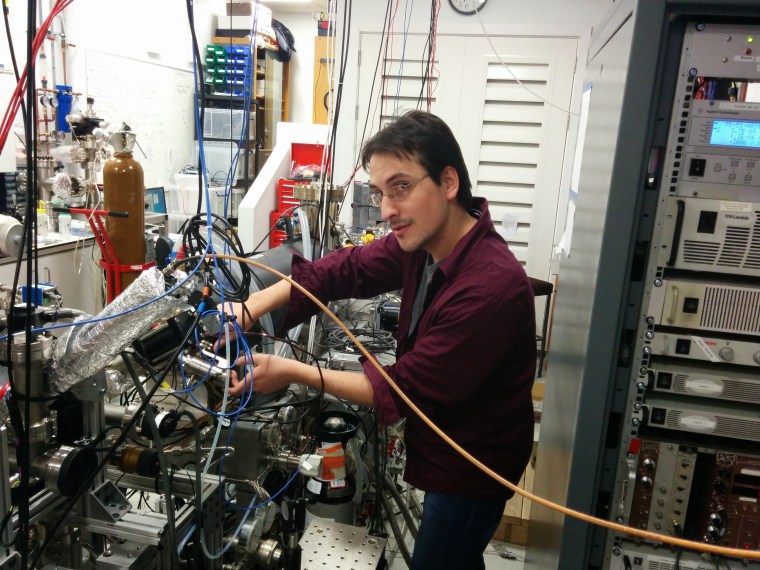
This past week Srdjan Marjanovic, a PhD student at the University of Belgrade, visited UCL to test some of the simulations he has been working on  (see above) using our positron trap.  One suggestion he made is to use CF4 for trapping, in lieu of nitrogen, the logic being that for the energies where inelastic collisions dominate many loss mechanisms are suppressed.  The main difficulty, however, is that many more collisions are needed to successfully capture the positrons, as the energy exchanged to excite vibrational transitions in CF4 is roughly 40 times less than for the electronic transition usually exploited with N2.  Unfortunately  we were unable to adapt our trap to work efficiently with CF4. Nonetheless, by trying we have learnt more about how our trap works and – most importantly –  Srdjan has new data he can use to refine his simulations.

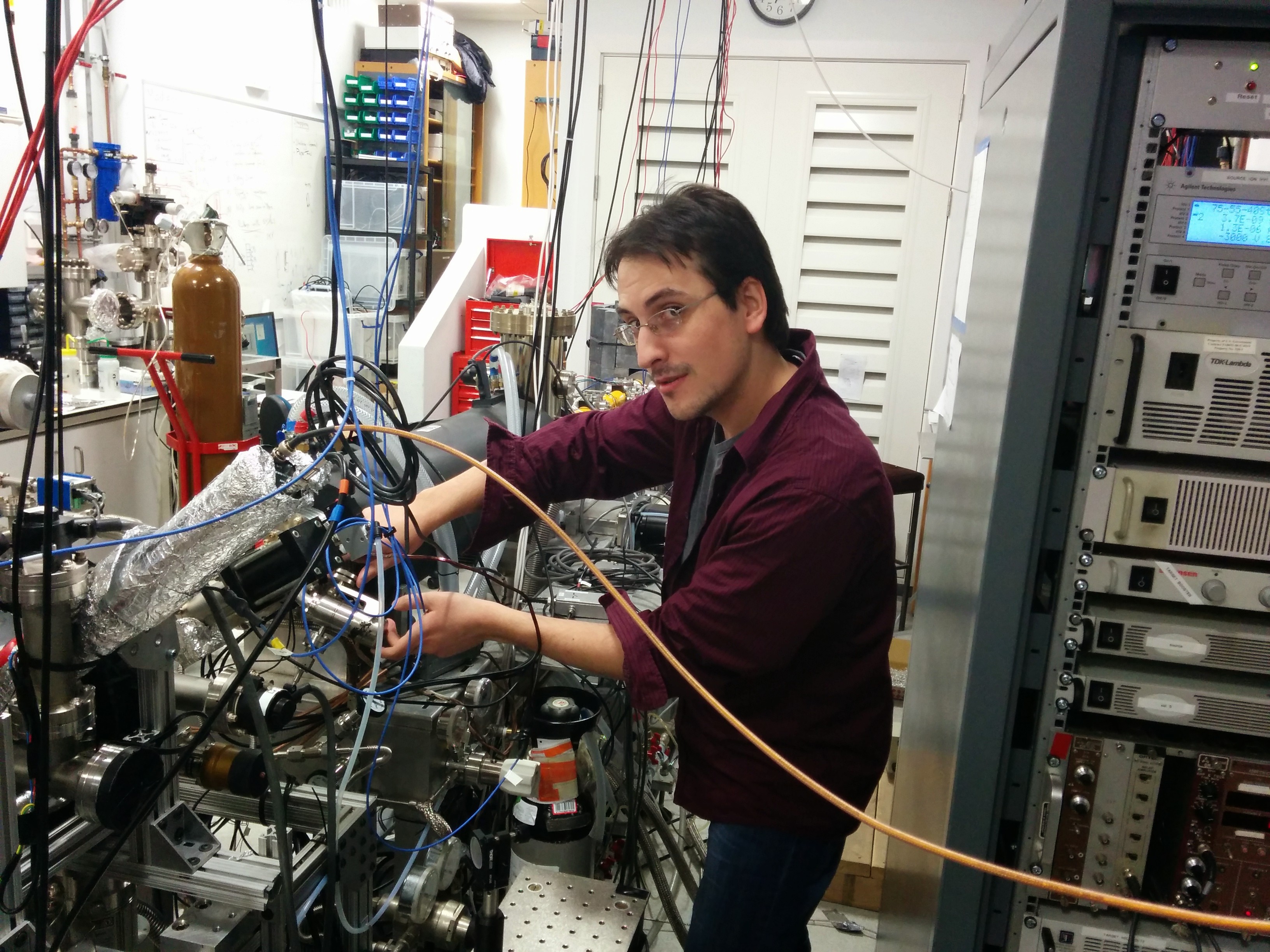
Photo.  Srdjan hard at work on the positron beam.
IMG_20150223_172039

Refs.
[1] Surko, C.M., Wysocki, F.J., Leventhal, M. and Passner, A. (1988). Accumulation and storage of low energy positrons. Hyperfine Interactions, 44:185–200. http://dx.doi.org/10.1007/BF02398669

[2] Surko, C.M. and Greaves, R.G. (2004). Emerging science and technology of antimatter plasmas and trap-based beams. Physics of Plasmas, 11(5):2333. http://dx.doi.org/10.1063/1.1651487

[3] Natisin, M.R., Danielson, J.R. and Surko, C. M. (2014) Positron cooling by vibrational and rotational excitation of molecular gases. J. Phys. B 47: 225209. http://dx.doi.org/10.1088/0953-4075/47/22/225209

Time-resolved Doppler spectroscopy

Positronium atoms created by implanting positrons into porous silica initially have ~ 1 eV kinetic energy, but subsequently cool by colliding with the inner surfaces of the porous network.  The longer spent inside the pores before being emitted to vacuum, the closer the Ps can get to thermalising with the bulk (i.e. room temperature, ~ 25 meV).

Once the positronium atoms make it out of the pores and into vacuum we can excite them using a 243 nm (UV) pulsed laser to n = 2, then ionize these with a 532~nm (green) laser. The amount of positrons resonantly ionised can be measured using SSPALS as the UV wavelength is slowly varied.  This gives us the 1s2p Doppler-width, from which we estimate the Ps energy.  The delay between implanting positrons and firing the 6 ns laser pulse was varied to try and see how the width changes when hitting the Ps cloud at different times.

2dplot

In the 3D plot above we see that at earlier times the Doppler width is broader than later on.  This is because Ps atoms that spend longer inside the silica have more collisions with the pores and therefore cool down further (narrowing the distribution at later times), mixed up with the simple fact that the fastest atoms reach the laser interaction region quickest, and pass through it more quickly too!

Positron beams, then and now

There have been positron beams in use at UCL since the early 1970’s since the first efficient positron moderator was discovered there by Paul Coleman, Karl Canter and co-workers [http://iopscience.iop.org/0022-3700/5/8/007]. The photograph below was taken in 1996, and shows a positron beam used in Dr David Cassidy’s PhD thesis (Positronium formation at surfaces and studies towards the production of cold antihydrogen, supervisor Mike Charlton, 1999). This beam, which is no longer operational, used a tungsten mesh grid as a moderator and produced around 1000 positrons/second. One can see a large diffusion pump at the lower end, and the black magnet coils used to guide the beam.
2215_001
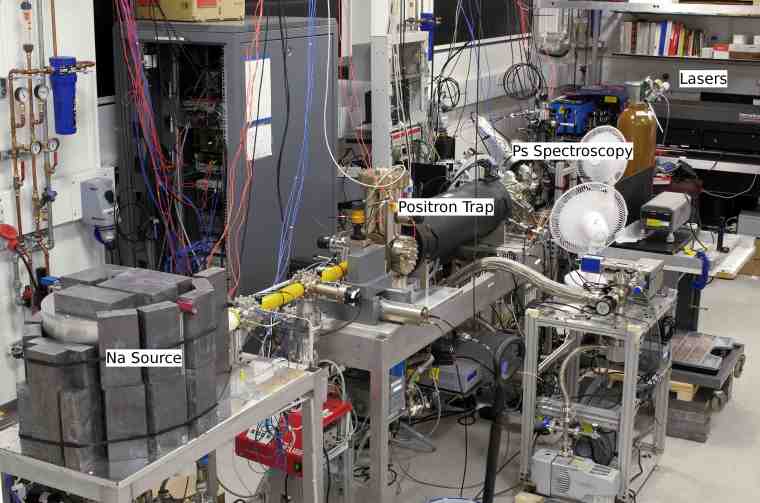
Things have changed quite a lot since those days. The current setup in our lab (shown below) at the moment uses a rare gas solid moderator (neon) and produces more than 5 million positrons/second. There are four main sections to this beamline, (1) the shielded Na source and moderator that produces positrons, (2) the positron buffer gas trap that provides the pulsed beam (5 ns wide pulses with 500,000 positrons each), (3) the Ps spectroscopy chamber where our Ps producing silica target is placed and (4) the laser table, where our Nd:YAG pumps our Sirah pulsed dye laser and our Radiant pulsed dye laser. Together all these components are used to produce Rydberg positronium in a two step photon process. There are no more diffusion pumps to be found!

lab_2

Rydberg Positronium and Stark broadening

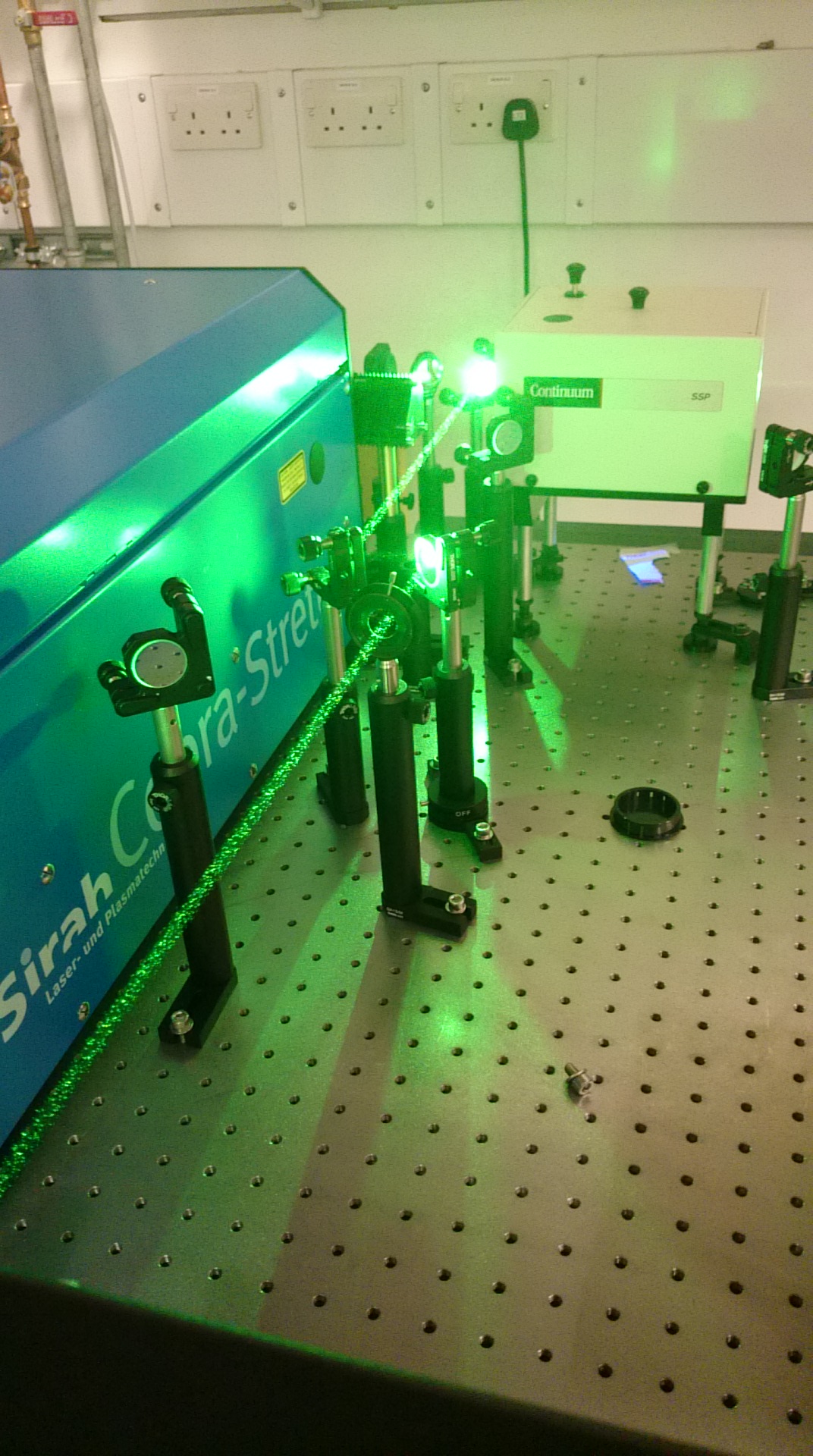
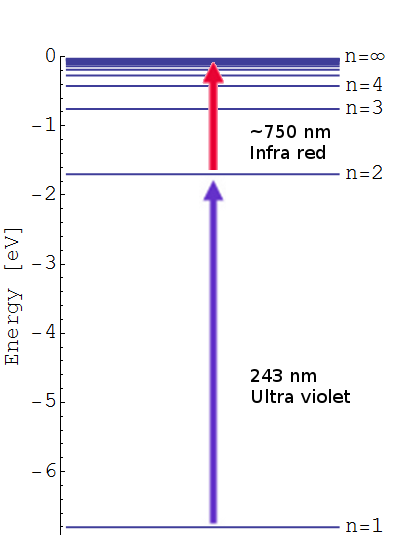
We have recently produced Rydberg positronium atoms in a two step excitation process, using 243 nm light from our broad band pulsed dye laser to excite 2P states, as in our previous Ps spectroscopy measurements. Then, instead of photoionizing with 532 nm light, we used ~ 750 nm light to excite 2p-nd transitions. This process is shown in the energy level diagram below, you can also see a photograph of the green light produced by our Nd:YAG laser pumping the infra red laser.

greenlight

Rydberg

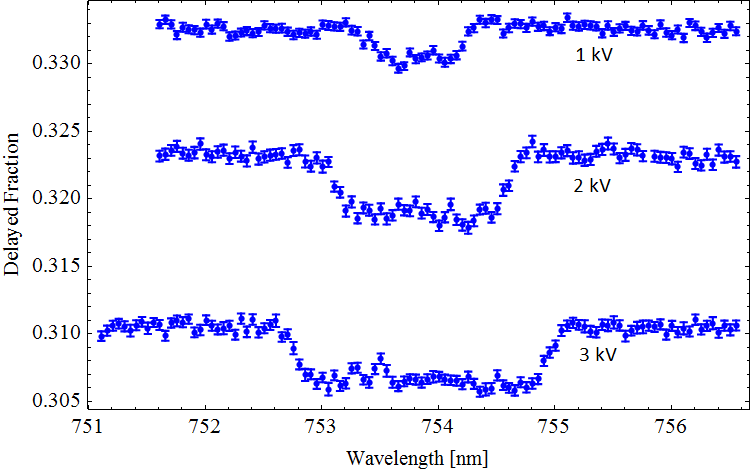
Once the Ps atoms have been excited to a Rydberg state, their lifetime is greatly increased, and they only annihilate once they collide with the vacuum chamber. This leads to a reduced delayed fraction in our positronium SSPALS signal, since there are less gamma ray events occurring on our delayed detection time (to read more about how we detect Ps, read here). This can be seen in our data below where we excited Ps atoms to n = 11.

Rydberg1kv2kv3kv

When atoms are subjected to a high electric field different states are separated and shifted leading to an overall broadening of the spectral line, this effect is known as Stark broadening,  the mixing and shifting of the states is proportional to the strength of the electric field being applied. We are able to observe this effect by varying the voltage  applied to our porous silica target from which Ps atoms are produced, and therefore changing the electric field that the Ps atoms are subjected to. As the voltage is increased, the broadening grows with the eclectic field, thus producing a signal over a wider range of infra red wavelengths, this is shown in the figure above where we plot the delayed fraction over a range of 5.6 nm, changing the voltage applied to our target from from 1 kV to 2 kV and 3 kV.

Positronium formation detected using annihilation radiation energy spectroscopy

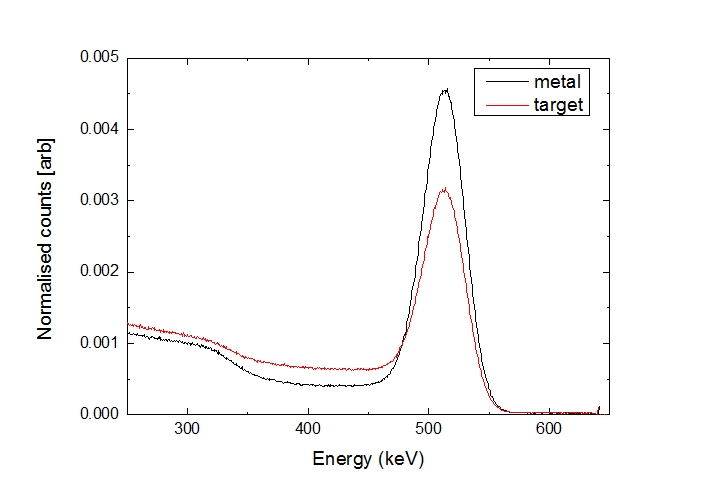
When a positron and an electron annihilate directly, instead of forming a Ps atom, all of their energy is converted into two gamma ray photons, each with 511 keV (the rest mass energy of the electron/positron). However, if an electron and a positron form a Ps atom the annihilation can occur either into two or three photons, depending on the spin state of the Ps atom. The longer-lived Ps state is called ortho-positronium (o-Ps), and in this system the electron and positron spins point in the same direction, so the total spin of the atom is 1. This means that o-Ps has to decay into an odd number of gamma rays in order to conserve angular momentum. Usually this means three photons, as single photon decay can only happen if there is a third body present (this has been observed). The three photon energies are spread out over a large range (but they always add up to 2 x 511 keV). The short-lived Ps state is called para-positronium (p-Ps) and this usually decays into two photons. It is possible for a three photon state to have zero angular momentum, so singlet decay into three photons is not ruled out by momentum considerations, but this mode is suppressed and to a good approximation p-Ps decays into two gamma rays with well-defined energies (i.e., 511 keV). This means that p-Ps decays look very similar to direct electron-positron decays. It also means that we can detect the presence of o-Ps by looking at the energy spectrum of annihilation radiation, as is shown in the graph below.

peakvalley3kV

We are able to measure gamma ray energies using a detector; in this case NaI(TI), or thallium doped sodium iodide. The data shown above were taken with a positron beam fired into a piece of untreated metal, from which we expect hardly any Ps to be made, and also in a silica film, which we know converts about 30% of the incident positrons into the Ps atoms. When the beam hits the metal many events at energies close to 511 keV are detected, since most positrons will annihilate directly into two 511 keV photons.
The production of Ps can be seen when we compare the two curves (red and black lines) shown in the figure. These spectra are normalised to have the same total area, so the excess of counts in the valley region (i.e., energies between about 300 and 500 keV), and the reduction of counts in the photopeak (at 511 keV) is exactly what you would expect if you made positronium: the decay into three photons means there are more photons with energies less than 511 keV.

New laser

We have set up our newest laser: a pulsed dye laser that will provide intense UV radiation with wavelength around 365 nm. We will focus this radiation to a small spot, irradiating the Ps atoms and driving two-photon transitions to Rydberg states of Ps. By retro-reflecting the UV radiation we will drive Doppler-free transitions, which will allow us to interact with a large range of atoms, covering the very wide Doppler-profile of the hot Ps atoms.

The advantage of this scheme is that we can drive the transitions to Rydberg states with narrow band pulsed dye lasers, which should allow us sufficient resolution to address individual Rydberg-Stark states when irradiating the atoms in a uniform electric field. This selective population will allow us to prepare the atoms in states ideal for manipulation with inhomogeneous electric fields, such as focussing and Rydberg-Stark deceleration.