Microwaves & Positronium Pt. III: Positronium Spectroscopy Cubed

A series of previous posts (found here, here and over here) described how our measurements of the positronium (Ps, an atom formed of an electron and its antimatter counterpart, the positron) 2 3S1 → 2 3PJ fine structure energy intervals were subject to significant shifts due to frequency dependent microwave power [1,2]. This variation in the power was due to reflections of the microwave radiation causing more power at some frequencies that others, skewing our measurements [3,4]. See the previous posts for a description of how we measure line shapes to determine the transition frequency. This post describes a new measurement of the 2 3S1 → 2 3P2 energy interval, known as the ν2 transition, performed using a waveguide with a new experimental design to eliminate reflection effects. The full published version of this work can be found in Reference [5].

The solution to the reflection problem, as determined from simulations of the microwave fields, was to use a vacuum chamber that minimised the possibility of microwave reflections going back into the waveguide and creating frequency dependent power variation (all our experiments are performed in a vacuum at <0.00000001% of atmospheric pressure to prevent the Ps scattering and annihilating). The vacuum chamber chosen was a cube, see Figure 1 for a diagram of the experimental layout. In this chamber the ends of the waveguide are just a few millimeters from the windows used to let in laser radiation, thus microwaves will pass out of the chamber as fused silica is transparent to microwaves, unlike metal which is highly reflective. This way we reduced the amount of reflected radiation and thus the frequency dependent power variation. Microwave absorbing foam with a reflectivity of <1% was placed on the windows, ensuring no microwaves were reflected back into the waveguide from outside the vacuum chamber.

Figure 1 A schematic diagram of the experimental setup showing the Ps (green) passing through the waveguide with the microwave absorbing foam (blue) at its exits. Adapted from Reference [5].

This experiment also had a few other improvements. Firstly, Doppler effects were minimised by retro-reflection of the UV laser beam used to make the 2 3S1 state Ps. If the laser Doppler selects atoms moving in one direction (away or towards the laser), then the retro-reflected beam, moving in an equal and opposite path, will select out atoms moving in the equal and opposite direction, resulting in a net zero velocity. Secondly, an extra wire mesh EG was included between the Ps production target ET, which has a large bias of -3.5 kV, and the waveguide to minimise electric field penetration into the microwave excitation region. Electric fields induce unwanted Stark shifts to ν2, but are attenuated strongly by wire meshes [6].

The quantum electrodynamic (QED) calculations we wish to test are for the zero-field case, where the atoms are in a region of no electric or magnetic field and do not interact with each other. The atoms in our experiment were a gas with less than 105 atoms per cubed centimeter and the electric fields present were very small. However, our experiment had to take place in a substantial magnetic field because this is how we guide our pulses of positrons to the location where we make Ps. A magnetic field will change the energy of quantum states (i.e. shifting where they lie in the electric potential well of the atom) and thus the energy intervals between states. This is called the Zeeman shift, and it is caused by an applied magnetic field distorting and polarising the probability distribution of the particles [7].

To get around this we measured the transition energy in multiple magnetic fields. The Zeeman shift is quadratic and could be extrapolated back to zero-field to obtain a value to compare with QED calculations. The measured transition energy νR (in MHz) is shown in Figure 2 as a function of magnetic field and the dashed lines are the extrapolations to zero-field. The figure shows data for microwave radiation moving toward the Ps atoms in two opposite directions, +x and –x, propagating in either direction along the waveguide. By taking the average of these two measurements we exactly cancel out any Doppler shifts between Ps and microwaves. However, the maximum Doppler shifts was expected to be ±0.26 MHz, based on the maximum possible misalignment of the Ps, laser and waveguide. This is much smaller than the 1.8 MHz difference observed, which is puzzling.

Figure 2 The measured Zeeman shifted transition frequency extrapolated back to zero field. The blue squares are the transition measured with microwave radiation travelling in the positive x direction, while the red circles are for the negative x direction. The green line and shaded band indicates the average measured zero-field transition frequency and its uncertainty. Hollow points are with microwave foam present and solid points are without microwave foam present. Adapted from Reference [5].

All other systematic effects are <0.1 MHz, yet the two directions disagree with each other. The prime suspect for this shift, reflection effects, was eliminated with the new chamber design and the foam. This was confirmed as shown in Figure 2 whereby data with foam (hollow points) and without foam (solid points) present does not display any change in the measured transition frequency. However, there was a small asymmetry to our line shape mesurements, which has previously indicated frequency dependent power [2]. This lead us to conclude that there were internal effects from defects in the waveguide construction or microwave circuit which caused frequency dependent power, distorting the line shapes. We treated this effect as a systematic error with a magnitude of 1.8/2 = 0.9 MHz, lowering the precision of our final result.

Our final value for the ν2 energy interval was 8627.94 ± 0.95 MHz, close enough to theory to be in broad agreement, as shown in Figure 3. This new value is the most precise measurement to date but fails to test the latest set of QED calculations, which can be described by a summation of smaller and smaller terms (i.e. ν2 = O4 + O5 + O6 + O7 + …). A measurement with just a ten times improvement in precision will be able to do this, and a 10000 times improvement would allow us to to test certain dark matter candidates [2]. We believe that this method has inherent vulnerabilities to frequency dependent microwave power and that other methods should be explored, a post on this will be coming soon. However, with improvements to the waveguide design and microwave circuit this methodology can be used for precision measurements nonetheless.

Figure 3 A comparison of our measurement of ν2 with historical ones, including the average of all the measurements so far. The vertical black line and shaded bar is the latest QED calculation and its associated error. Adapted from Reference [5].

[1] Precision Microwave Spectroscopy of the Positronium = 2 Fine Structure. L. Gurung, T. J. Babij, S. D. Hogan and D. B. Cassidy; Phys. Rev. Lett.125, 073002 (2020)

[2] Observation of asymmetric line shapes in precision microwave spectroscopy of the positronium 23P1 23PJ (J = 1, 2) fine-structure intervals. L. Gurung, T. J. Babij, J. Pérez-Ríos, S. D. Hogan and D. B. Cassidy; Phys. Rev. A.103, 042805 (2021)

[3] Line-shape modelling in microwave spectroscopy of the positronium n = 2 fine-structure intervals. L. A. Akopyan, T. J. Babij, K. Lakhmanskiy, D. B. Cassidy and A. Matveev; Phys. Rev. A. 104, 062810 (2021)

[4] Microwave spectroscopy of positronium atoms in free space. R. E. Sheldon, T. J. Babij, S. H. Reeder, S. D. Hogan, and D. B. Cassidy; Phys. Rev. A 107, 042810 (2023)

[5] Precision microwave spectroscopy of the positronium 2 3S1 →2 3P2 interval. R. E. Sheldon, T. J. Babij, S. H. Reeder, S. D. Hogan, and D. B. Cassidy; Phys. Rev. Lett. 131, 043001 (2023)

[6] Penetration of electrostatic fields and potentials through meshes, grids, or gauzes. F. H. Read, N. J. Bowring, P. D. Bullivant, and R. R. A. Ward; Rev. Sci. Instruments, 69 (5), 2000–2006 (1998)

[7] Atomic physics. C. J. Foot; Oxford master series in physics, Oxford University Press (2005)

Microwaves & Positronium Pt. II: Giving Positronium the Horn (Antenna)

A previous post of ours (found here) described how our measurements of the energy intervals of the n = 2 positronium (Ps) fine structure produced asymmetric line shapes [1], see Figure 1(a). A line shape represents the probability of transferring an atom from one quantum energy state to another as a function of the applied photon energy. In this case the photons are in the microwave regime at a frequency of ~8.6 GHz as we are looking at the 2 3S1 to 2 3P2 state transition, known as ν2. For details on how we make and measure these lineshapes, and what 2 3S1 means see the previous post linked above.

The reason we do these measurements is that they are tests of quantum electrodynamics, and can reveal new physics beyond the standard model [2]. The energy interval ν2, given in MHz, can be retrieved as the central frequency of the line shape and compred to theoretical calculations. But if there is something distorting the measurement that we cannot account for then the precision we obtain will be limited and the test not as effective. Thus the asymmetry in the previous measurement meant that a value of ν2 could not be extracted from the line shape due to the lack of a suitable theoretical model that would account for the asymmetry.

Figure 1 A comparison of line shapes generated using a waveguide (a) and a horn antenna (b). Adapted from References [1, 4].

The previous measurement used a waveguide, which is a structure designed to allow certain microwave frequencies to propagate with high intensity and uniformity. The cause of the line shape asymmetry was reflection effects, whereby microwaves escaped the open ends of the waveguide and were reflected back in [3]. The power reflected back into the waveguide varied as a function of microwave frequency because the changing wavelength altered the reflections in the chamber. This frequency dependent power distorted the line shapes, introducing asymmetry and apparent shifts to the energy interval we want to measure.

So having performed a measurement suffering from reflection effects we decided to make them much much worse. For the peer reviewed work summarised in this article click here [4]. Instead of a waveguide we used a horn antenna which allows microwave radiation to be coupled from a source into free space, removing the spatial restrictions of the waveguide (which was 12.6 mm x 25.8 mm in size, a WR-112 as it is known). In this experiment we placed the horn antenna outside the vacuum chamber where the Ps is made at a distance of up to 34 cm from the Ps, see Figure 2. The microwaves entered the chamber through a fused silica window where they could address the Ps atoms.

Figure 2 A schematic diagram of the experimental setup. The Ps atoms (green shading) are emitted toward the right hand side of the vacuum chamber (dark grey). Microwave radiation (yellow shading) is incident from the horn antenna (purple) into the vacuum where it intersects the Ps. Adapted from Reference [4].

The distance between the horn antenna and the chamber should allow the radiation to propagate and become plane waves (radiation that has each peak of the wave travelling parallel to one another), in what is known as the far-field regime [5]. Plane waves should have uniform polarisation and power distribution. However, due to the metal chamber and electrodes there was a significant amount of reflection inside the chamber, much more than in the waveguide. This can be seen in Figure 3 (a & c) which shows a 2-D map of the simulated microwave field strength inside the vacuum chamber, and 3 (b & d) which shows the polarisation of the same data. In an ideal world these would show a uniform block of colour indicating uniform field strength and polarisation, but it really does not. This effectively randomised microwave field increases the frequency dependent power variation felt by the Ps atoms, amplifying distortions to the line shape.

Figure 3 A simulated map of the electric field strength (b & d) and polarisation (a & c) of the microwave radiation ued in this work. The horn antenna and vacuum chamber were simulated, with the outline of the latter shown in grey. The upper and lower set of plots are for different microwave frequencies and you can see the difference in field pattern between the two for both field strength and polsarisation. From Reference [6].

The lineshape you see in Figure 1(b) is symmetric, unlike the previous measurement of ν2. However, this measurement does show a shift from the theoretical prediction of the energy interval. There were two causes we thought most likely to explain this shift: (a) the atoms had a preferential motion towards/away from the horn creating a Doppler shift (the change in frequency of light due to the motion of the target, i.e. when moving towards something you percieve the peaks of the wave being closer together and so see a higher frequency of light), or (b) the microwave reflections were causing a shift even without an asymmetry. The way we tested this was by varying the horn antenna angle θH with respect to the Ps. By rotating the horn we can select the subset of Ps atoms moving towards or away from the microwave radiation and change the Doppler shift with a certain angular dependency.

What we found was a ~300 kHz/degree shift, see Figure 4, which is much larger and of opposite magnitude compared to the expected Doppler shift of -40 kHz/degree. We therefore ruled out Doppler shifts as a possible explanation. In fact the shift we saw would have to come from all atoms moving directly towards the antenna at -10o and away from the antenna at +10o which, given our experiment, was implausible. Other possibilities such as ac Stark shift, spatial selection effects, polarisation effects, and stray electric fields were excluded for being too small in magnitude or not dependent on the horn orientation.

Figure 4 The angle dependent shift of the transition frequency as measured during our experiment. The horizontal dashed line is the expected theoretical transition frequency. The angled dashed lines are linear fits to the data to quantify the observed shift. Adapted from Reference [4].

It would appear that this shift is therefore due to reflection effects, which is not surprising given the distorted line shapes observed in waveguide measurements where reflections were much less dominant. We therefore concluded that a horn antenna as a source of free space microwaves is not an ideal way to perform precision measurements of Ps. But the technique further demonstrates the nature of reflection effects in line shape measurements over a broad frequency range. An interesting feature is that the line shapes show no asymmetry but display large shifts, confirming the previously simulated data that showed a shift can manifest without an associated asymmetry [3] and therefore removal of reflections must be demonstrated beyond verification of symmetric line shapes.

If we wish to test QED in Ps using these microwave regime transitions we must remove reflections as a source of error. We believe that by using a different chamber with less reflective surfaces at the ends of the waveguide we can remove these reflections. Simulations with this new chamber have demonstrated this is indeed the case. Figure 5 shows the change in strength of the microwave field in a waveguide inside a new, modified vacuum chamber (called the Cube) versus the one used to make the previous asymmetric measurements (called the Cross) [1]. The field is over three times more uniform in the newly designed chamber than the old. Thus we intend to replicate the waveguide measurement with the new chamber (and other improvements) to probe bound state QED.

Figure 5 The variation in the electric field strength of the microwave radiation in a waveguide as a function of microwave frequency for three different cases. Adapted from Reference [7].

[1] Observation of asymmetric line shapes in precision microwave spectroscopy of the positronium 2 3P1 → 2 3PJ (J = 1, 2) fine-structure intervals. L. Gurung, T. J. Babij, J. Pérez-Ríos, S. D. Hogan and D. B. Cassidy; Phys. Rev. A.103, 042805 (2021)

[2] Precision physics of simple atoms: QED tests, nuclear structure and fundamental constants. S. G. Karshenboim; Phys. Rep. 422, 1 (2005)

[3] Line-shape modelling in microwave spectroscopy of the positronium n = 2 fine-structure intervals. L. A. Akopyan, T. J. Babij, K. Lakhmanskiy, D. B. Cassidy and A. Matveev; Phys. Rev. A. 104, 062810 (2021)

[4] Microwave spectroscopy of positronium atoms in free space. R. E. Sheldon, T. J. Babij, S. H. Reeder, S. D. Hogan, and D. B. Cassidy; Phys. Rev. A 107, 042810 (2023)

[5] Microwave Engineering. David M. Pozar; 4th Edition (2012)

[6] Tests of Quantum Electrodynamics Using n = 2 Positronium. R. E. Sheldon; PhD Thesis, University College London (2024)

[7] Precision microwave spectroscopy of the positronium 2 3S1 →2 3P2 interval. R. E. Sheldon, T. J. Babij, S. H. Reeder, S. D. Hogan, and D. B. Cassidy; Phys. Rev. Lett.131, 043001 (2023)

From molecular to positronium spectroscopy

My name is Krzysztof and I’m a new PhD student in the positronium spectroscopy group, but by no means new to UCL. I have recently completed my undergraduate degree in the Department of Chemistry and throughout my course I had multiple opportunities to work with various types of spectroscopy. In this short introduction I will present my recent experience in the Laboratory of Rotational Spectroscopy in the Institute of Physics of Polish Academy of Sciences (IF PAN).

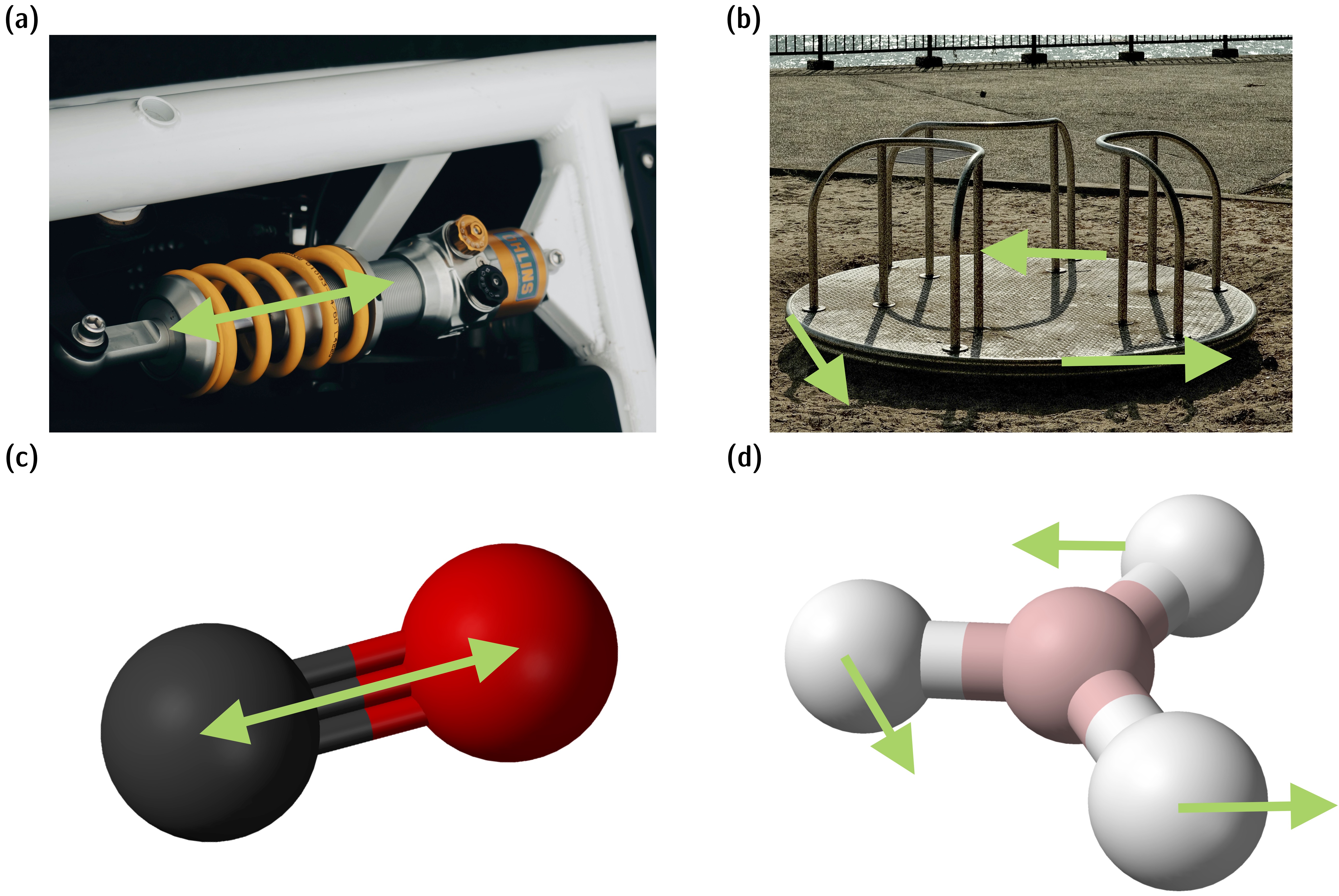
Molecules, unlike unbound atoms, posses quantum states related to their relative nuclear motion. Nuclei within a molecule change their position with respect to one another while maintaining the centre of mass coordinate. One of these types of motions, vibration, can be described as if the nuclei were connected by an interatomic spring which oscillates at a certain frequency (Figure 1 a and c). Another type of motion, the main topic of this post, is rotation, where the molecule revolves around an axis and may be described by the classical motion of a spinning top or a merry-go-round (Figure 1 b and d).

Cartoon depiction of molecular motions: top left: a spring with the axis of motion shown with a green arrow; bottom left: carbon monoxide molecule with axis of bond stretching; top right: merry go round with arrows indicating its rotational motion; bottom left: borane with arrows indicating its rotational motion in plane of the molecule.
Figure 1: A cartoon depiction of two molecular motions. Vibration in carbon monoxide (c) is similar to the motion of a classical spring (a). In-plane rotation in borane (d) is similar to the motion of a merry-go-round (b). Photo (a) by Joshua Marks and (b) by David Gan.

In a classical picture, the energy of a rotor Erot(ω) is proportional to the moment of inertia I multiplied by the square of the angular velocity ω,

Erot(ω) = I ω2.

The angular velocity ω is defined as the change in orientation of a rotating body per unit of time (e.g. 1 rotation per second is 2π rad s-1), while the moment of inertia is a measure of the force needed to accelerate a rotating body.

On a molecular scale, the rotational energy is quantised, i.e. it can only take certain discrete values. For example, in the case of a linear molecule like carbon monoxide (Figure 1c), the rotational energy levels take values of integer multiples of hcB,

Erot(J) = h c B J ( J + 1 ),

where J is the rotational quantum number, B is the rotational constant, c is the speed of light in vacuum, and h is the Planck constant. The rotational quantum number is similar to the angular velocity ω in the classical case, while the constant B is proportional to moment of inertia of a molecule. This gives rise to discrete energy levels at 0, 2hcB, 6hcB, 12hcB

This, and a very similar quantisation for vibrational energy, gives rise to a complex energy level structure on top of the electronic energy levels already present (see a previous article for an explanation of the electronic energy levels in atoms). Each electronic energy level possesses many vibrational states, usually denoted with vibrational quantum number ν. These states are not discussed in detail in this article, but shown in Figure 2 a. Each ν state has its own rotational structure with sub-states denoted with J, see Figure 2 b. It is worth noting that ν is used to represent the vibrational quantum number as well as for frequency.

A molecular energy level diagram with morse potential for ground and first excited electronic state depicting vibrational levels and rotational levels depicted for two example vibrational levels \nu=0,1. Three arrows depicting transitions, blue - electronic, green - vibrational and red - rotational.
Figure 2: Schematic diagram of vibrational (A) and rotational (B) structure of the ground and first electronic excited state of a molecule. A pure electronic (blue), vibrational (green) and rotational (red) transition are shown on the diagram as arrows. From Ref. [1].

It is possible to excite transitions between vibrational and rotational levels using photons, just as between electronic states. These transitions are subject to selection rules, and most predominantly occur in the infrared and microwave regimes of the electromagnetic spectrum. Spectroscopy in this region of the electromagnetic spectrum can be a perfect tool for astrophysical surveys of different molecular species in space, if coupled with a good theoretical foundation [2]. For more details about the principles of rotational spectroscopy refer to Atkins Physical Chemistry [3], or this short overview article from an experimental perspective [4].

Rotational spectroscopy is a great tool for studying the composition of the universe. By identifying transitions unique to a certain molecule, called fingerprint transitions, we can determine the molecular contents of the interstellar medium. Major collaborative experiments like the Atacama Large Millimeter/Submillimeter Array (ALMA), the Herschel Space Observatory for the Far-Infrared, the James Webb Space Telescope, and the recently launched Euclid mission (see the video from launch here!), collect data from vast regions of space. This data can be used to study the contents of the matter suspended between stars thanks to, among many techniques, rotational spectroscopy.

To identify a substance from the spectral data we need to have a very good model to reconstruct the molecular spectrum for a candidate species and compare it with actual data. To do that, we have to know certain characteristics of a molecule which we can obtain from a calculation or an experiment (preferably both).

The magnitude and orientation of the electric dipole moment μe is one of these fundamental properties which determine the molecular spectrum. The electric dipole moment of a molecule is defined as the separation between the point charges multiplied by their charge. As the intensity of the transition is proportional to \mu_{e}^{2}, it is crucial to know the electric dipole moment in order to determine the relative population of the molecules in the environment being observed.
To probe μe we can use the Stark effect. In an electric field, the rotational transitions split into separate components, known as Stark lobes. The difference between the Stark shifted frequency νs and original frequency ν0, Δνs = νsν0, is approximately proportional to the square of the electric field. To read more about the Stark effect, refer to our previous article. Measurements of the Stark lobe frequency difference Δνs for n-propanol are shown in Figure 3.

Graph of stark shift (in MHz) over square of the voltage applied to the electrodes (Volts squared). Three linear lobes visible for two transitions.
Figure 3: Stark lobes of n-propanol (conformer Aa) for two rotational transitions plotted as Stark frequency shift Δνs as a function of voltage applied to the electrodes. As Δνs is proportional to the square of the magnitude of the electric field and the separation between electrodes is kept constant at 26.97 cm, Δνs is also proportional to the voltage squared. The measured Δνs (white circles) have been fitted in QSTARK [8]. Figure and more details in Ref. [5].

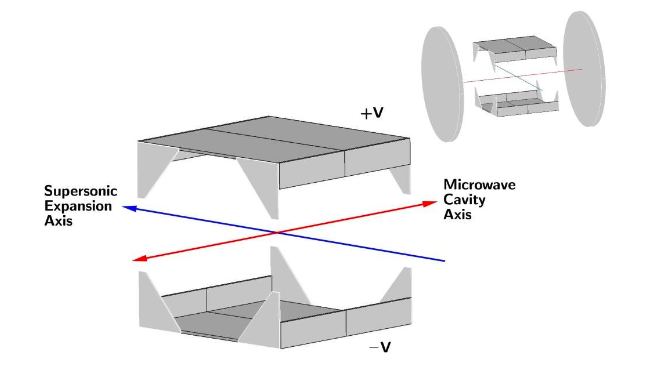
The transitions are measured by coinciding a low temperature supersonic beam of molecules with a microwave cavity, inside which is a region of well defined electric field. A schematic of this is shown in Figure 4. By measuring the energy splitting of the Stark lobes of transitions at different values of the electric field and fitting the obtained frequency shifts Δνs with a theoretical model [7] we can obtain the magnitude and orientation of the electric dipole moment, as already shown in Figure 3.

On left: two Stark electrodes with positive and negative voltage. In between two intersecting lines: supersonic expansion axis and microwave cavity axis. On rightL the setup described previously in between the microwave cavity.
Figure 4: Schematic drawing of the experimental setup consisting of the Stark electrodes, Fabry–Pérot resonator with perpendicular axes of the microwave cavity and supersonic expansion. From Ref. [5].

Ideally we would hope to record the spectrum of only one molecular species at a time to minimise any ambiguities. Unfortunately another complication, non existent in positronium or atomic spectroscopy, is freedom of the molecular bonds to rotate. The same molecule can occur in several different geometries, called conformations. For example, in n-butanol four bonds with torsional freedom result in 14 possible conformers, shown in Figure 5. Fortunately for the experiment, conformers vary in energy. Within the temperature regime of the molecules in this experiment, two conformers of n-butanol were fully characterised as the other, higher energy ones, were suppressed by the low temperature.

Diagram of n-butanol with three possible angles originating from four possible torsional motions of molecular bonds. Theta defined as angle between oxygen and first carbon, phi 2 as angle between carbon 1 and 2, and phi 3 between carbons 2 and 3. In theta 1 we have two possible conformersL trans and gauche. From theta 1 gauche we choose trans or gauche conformation (theta two) and another trans or gauche and trans, gauche and gauche' respectively. From phi 1 gauche we choose trans, gauche or gauche' (phi 2) from which we choose trans, gauche or gauche' for each three. This results in 14 possible conformations.
Figure 5: Possible n-butanol species with different geometries called conformers with a handy diagram showing how to construct them from three possible angles of torsion. From Ref. [6].

In summary, the electric dipole moment μe magnitude and orientation was experimentally determined for n-propanol using a Stark splitting measurement of rotational transitions. The values measured were a significant improvement in precision over previous measurements. For example, in n-propanol (Figure 6) the new experimental value of μe corresponds to an increase in intensity of some transitions by almost a factor of three with respect to previous results [5]. These findings aid astrophysical exploration of space by allowing more accurate analysis of spectral signals being acquired by multiple experiments.

nprop
Figure 6: Main result of the experiment: electric dipole moment magnitude and its components along the molecular principal axes for n-propanol Aa conformer along a schematic depiction. From Ref. [5].

Using positronium (the bound state of an electron and its antiparticle, the positron) you can measure the Rydberg constant with no perturbations from the less well understood quantum chromodynamics, which is present in each molecular species mentioned above and all conventional atoms with nuclei. This will require precise knowledge of the Stark effect and electric fields, as well as the use of millimetre-waves to measure electronic transition energies between high n Rydberg positronium states. This prior experience in experimental physics during my undergraduate studies was a great introduction to the kind of work which I will undertake with positronium during my doctorate.

[1] S. S. Harilal, B. E. Brumfield, N. L. LaHaye, K. C. Hartig, and M. C. Phillips, “Optical spectroscopy of laser-produced plasmas for standoff isotopic analysis”, Appl. Phys. Rev., vol. 5, 021301, 2018. DOI: 10.1063/1.5016053

[2] Z. Kisiel, “Assignment and Analysis of Complex Rotational Spectra” in Spectroscopy from Space. NATO Science Series, vol. 20. pp 91-106, Springer, Dordrecht (2000). DOI: 10.1007/978-94-010-0832-7_6

[3] P. Atkins, J. de Paula, and J. Keeler, “Topic 11B: Rotational Spectroscopy” in Atkins’ physical chemistry (12th ed.), pp 440-451, Oxford (2018). Access in BibliU

[4] Z. Kisiel, “THz Molecular Spectroscopy“, in Encyclopedia of Modern Optics (II ed.), pp 387-402 (2018), DOI: 10.1016/B978-0-12-803581-8.09638-7

[5] Z. Kisiel and K. Habdas, “Electric Dipole Moments from Stark Effect in Supersonic Expansion: n-Propanol, n-Butanol, and n-Butyl Cyanide“, Molecules, vol. 28, 1692, (2023) DOI: 10.3390/molecules28041692

[6] Z. Kisiel, J. Kosarzewski, and L. Pszczółkowski, “Nuclear Quadrupole Coupling Tensor of Ch2Cl2: Comparison of Quadrupolar and Structural Angles in Methylene Halides, Acta Phys. Pol., vol. 92, 3, pp. 507-516, (1997) DOI: 10.12693/APhysPolA.92.507

[7] Y. Kawashima, Y. Tanaka, T. Uzuyama, and E. Hirota, “Conformations and Low-Frequency Intramolecular Motions of 1-Butanol, 1-Butanethiol, Iso-butanol, and Iso-butanethiol Investigated by Fourier Transform Microwave Spectroscopy Combined with Quantum Chemical Calculations“, J. Phys. Chem. A, vol. 125, 5, pp 1166-1183, (2021) DOI: 10.1021/acs.jpca.0c09687

[8] Z. Kisiel, J. Kosarzewski, B.A. Pietrewicz, L. Pszczółkowski, “Electric dipole moments of the cyclic trimers (H2O)2HCl and (H2O)2HBr from Stark effects in their rotational spectra“, Chem. Phys. Lett., vol. 325, 5-6, pp 523-530, (2000) DOI: 10.1016/S0009-2614(00)00729-6

Acknowledgements

Many thanks to Prof. Dr hab. Zbigniew Kisiel and ON2.3 laboratory of Vibrational and Rotational Spectroscopy for this great research experience. The Turing scheme travel fund is also appreciated.

From antihydrogen to positronium spectroscopy

Introduction and PhD motivation

As a new member of the group I would like to introduce myself and my background in physics: I am Andi, coming from Vienna, where I did my bachelors and masters degree in physics at the University of Vienna. Since 2019 I’ve been doing my PhD at the Stefan Meyer Institute for subatomic physics in Vienna as part of the ASACUSA-Cusp (Atomic Spectroscopy And Collision Using Slow Antiprotons) collaboration in the antiproton decelerator (AD) facility at CERN.

The ASACUSA-Cusp experiment aims to measure a property called the hyperfine splitting of antihydrogen [1]. Antihydrogen (\overline{\text{H}} ) is the antiatom of hydrogen, consisting of a positron (e+) and an antiproton (\overline{\text{p}} ), i.e. the antiparticles of electrons and protons, respectively. An antiparticle has the same mass and same absolute charge value as the matter-particle, but opposite sign of the electric charge and magnetic moment. As an example the antiproton has a charge of -1 while the proton has a charge of +1, but both have the same mass. A fundamental property of antimatter is that if it comes close to its matter counterpart both will annihilate and produce a photon. According to the current model of particle physics, the Standard Model, matter-antimatter pairs can be produced by high-energy interactions (the famous formula for the equivalence of energy and mass E = m c2 makes that possible). The energy available for the production of a particle-antiparticle pair must be at least the energy equivalent to the mass of the particles produced, for example to produce an electron-positron pair you need at least 2\times511 = 1022 keV of energy. However, they would annihilate again if not separated. This creation-annihilation processes occurred at short times after the Big Bang but must have stopped at some point as we are living in a universe built from matter. Which leads to the question: Where did the antimatter go?

As hydrogen is the most investigated element it opens the possibility to compare properties to antihydrogen to look for differences, which could give a hint for physics beyond the standard model (in the case of the ASACUSA experiment the framework used is called Standard Model Extension [2,3], but that goes deeply into quantum field theory and will not be further described), which might explain the missing antimatter in our universe.

Experimental setup

The experimental setup is sketched in Fig.1. (I will not go into detail about the spectroscopy setup as it was not used during my time in the collaboration, but for further information you can look up “Rabi experiment” or have a look at the original publication [4]). The positrons come from a 22Na source, are moderated by a solid Ne moderator[5], and are accumulated in a so-called Buffer Gas Trap [6]. This is done the same way as the Positronium experiments here at UCL, for more information click here. Antiprotons are produced at CERN via the process \text{p} + \text{p} \rightarrow \text{p} + \text{p} + \text{p} + \overline{\text{p}} by shooting high energy protons at tungsten and iridium targets. The energy of the incoming proton must be higher than two times the rest mass of the proton to produce the additional proton-antiproton pair. As the particles have different charge, they can be separated easily by an electric field, protons going one way and antiprotons going the other. The antiprotons can be decelerated afterwards in two rings (the AD and ELENA) to about 100 keV.

Fig.1: Sketch of the ASACUSA experiment. The positrons (red) and antiprotons (blue) are used to produce antihydrogen (purple). Shown are the positron system, the antiproton trap (MUSASHI), the antihydrogen production trap (double-CUSP), the spin-flip cavity, the analysing sextupole and the detector. From Reference [7].

The main process to form antihydrogen is called three-body recombination (\text{e}^+ + \text{e}^+ + \overline{\text{p}} \rightarrow \overline{\text{H}} + e^+ ). That means that a large number of positrons (a few million) and antiprotons (a few hundred of thousand) have to be close together. That is achieved in so-called Penning-Malmberg traps, which is a slightly modified version of a real Penning trap (but the same methods are used). A Penning-Malmberg trap consists of a stack of typically cylindrical electrodes on which different voltages can be applied, producing an on-axis potential (as indicated in Fig.2). Particles with energies lower than the potential barrier cannot escape axially. However, they are pushed towards the wall of the electrodes radially. To counteract this movement, a magnetic field parallel to the electrodes is applied (depending on the purpose of the trap the magnetic field can vary from a few mT up to several T). The particles have no option to escape from the trap, neither axially nor radially, hence they are trapped in a specific region.

Sketch of a Penning-Malmberg trap. The magnetic and electric field as well as a sketch of the on-axis potential along the trap are shown.

By using this type of trap it is possible to accumulate high numbers of particles with the same charge (e.g. positrons). When a certain density is reached, the particles start to act as an ensemble, which is called a non-neutral plasma. For the production of antihydrogen typically non-neutral plasmas of positrons are needed. By having positrons and antiprotons in the same trap it possible to get an overlap of the positron and antiproton plasmas and the antihydrogen production reaction can start. As antihydrogen is electrically neutral, it can leave the trap and a measurement can be performed.

My previous work

During my PhD my focus lay in upgrading the positron system. I replaced the previous moderation system and buffer gas trap, commissioned an additional trap for accumulating a high number of positrons and optimised the systems. Additionally, I have participated in the design phase, assembly and testing of the new antihydrogen production trap. A further part of my work was the optimisation of the positron plasma before the production of antihydrogen in this trap.

As the AD is not operating all the time, i.e. there are periods when no antiprotons are delivered, the ASACUSA collaboration designed, built and commissioned a low energy proton source [8]. With this source it is possible to use the same apparatus to produce hydrogen when no antiprotons are available for optimising the production scheme. The installation, testing and optimisation of the proton source in the experiment was another part of my PhD.

Future project

As a research fellow I am working in the group of David to set up an experiment to measure the influence of gravity on Rydberg positronium. The first step will be to build a new positron beamline, similar to the one I used at CERN. In parallel we are designing the apparatus for bending positronium upwards using an electric field. This will be a first milestone for the experiment, but that will be expanded upon in a different blog entry.

References

[1] E. Widmann, R. Hayano, M. Hori, and T. Yamazaki, “Measurement of the hyperfine structure of antihydrogen”, Nuclear Instruments and Methods in Physics Research Section B: Beam Interactions with Materials and Atoms, vol. 214, pp. 31–34, 2004. Low Energy Antiproton Physics (LEAP’03).

[2] D. Colladay and V. A. Kostelecký, “Lorentz-violating extension of the standard model,” Phys. Rev. D, vol. 58, p. 116002, Oct 1998.

[3] V. A. Kostelecký and A. J. Vargas, “Lorentz and cpt tests with hydrogen, antihydrogen, and related systems,” Phys. Rev. D, vol. 92, p. 056002, Sep 2015.

[4] I. I. Rabi, S. Millman, P. Kusch, and J. R. Zacharias, “The molecular beam resonance method for measuring nuclear magnetic moments. the magnetic moments of 3Li6, 3Li7 and 9F19,” Phys. Rev., vol. 55, pp. 526–535, Mar 1939.

[5] J. Mills, A. P. and E. M. Gullikson, “Solid neon moderator for producing slow positrons,” Applied Physics Letters, vol. 49, pp. 1121–1123, 10 1986.

[6] T. J. Murphy and C. M. Surko, “Positron trapping in an electrostatic well by inelastic collisions with nitrogen molecules,” Phys. Rev. A, vol. 46, pp. 5696–5705, Nov 1992.

[7] B. Kolbinger, et al., “Measurement of the principal quantum number distribution in a beam of antihydrogen atoms,” The European Physical Journal D, vol. 75, p. 91, Mar 2021.

[8] A. Weiser, A. Lanz, E. D. Hunter, M. C. Simon, E. Widmann, and D. J.Murtagh, “A compact low energy proton source,” Review of Scientific Instruments, vol. 94, p. 103301, 10 2023.

CATMIN III

In July this year UCL hosted the CATMIN III: Frontiers in Rydberg Physics conference, co-organised by groups from Innsbruck, Harvard and UCL. Topics included Rydberg atom qubits for quantum computers [1], precision measurements of QED and fundamental constants [2], Rydberg molecule studies [3] and field sensing [4]. Our whole group attended, including our undergraduate summer students Yizhen and Carolina.

The group photo of CATMIN III in front of the UCL portico

David gave a broad presentation on Positronium Rydberg physics, including studies performed at UCL, most of which can be found on our publications page and a full video of the talk can be found on YouTube. Sam and I presented posters on ongoing work, both of which can be found in the downloads section. Sam is using Rydberg helium (He) to probe fields inside a microwave waveguide recently used to perform precision studies on the Ps n = 2 fine structure in which significant energy level shifts have been observed [5]. Given the sensitivity of Rydberg He to radio frequency, electric and magnetic fields and much better statistics compared to Ps we can investigate imperfections in the waveguide, a possible source of the shift found in Ps. A full blog post on this will be published soon.

My poster was on experiments done to observe THz (mm-wave) transitions in Rydberg Ps. For years the THz regime of the electromagnetic spectra (0.3 – 30 THz) was known as ‘the THz gap’, a band of EM radiation that is very hard to produce, lying between electronic methods at low photon energy and optical methods at high photon energy. However, much progress has been made in the last decade and there now exists commercially available technology (albeit for an extortionate price, a total of £90,000 for everything required) to generate radiation up to 1.7 THz. We are trying to measure the transition frequency between high n Rydberg states, in particular n = 21 – 24 which has a frequency of 0.874 THz. My poster described apparatus for this measurement but unfortunately, we have not yet seen any THz transition. We think the reason for this is that we have too little power (£90k only gets you 16 uW of THz power) or our statistics are too poor. Once this is working we can obtain a value for the Rydberg constant in a purely leptonic system which has advantages over the hadronic systems typically used (i.e. conventional atoms) [6]. This THz measurement can be done to examine systematics before an n = 2 – 21 measurement is performed for high precision result.

As well as the talks, we engaged in a different form of collaboration on Wednesday afternoon as there was a football match and a rounders game in Regents Park (we, of course, did very well… ish). After a somewhat achy Thursday there was a spectacular conference dinner at the Ambassador Hotel in Bloomsbury where the organiser of CATMIN IV gave a speech. We’d like to thank the organisers for hosting the event and allowing us to speak and look forward to CATMIN IV in Grenoble in the near future.

Sport!!
Rounders in Regents Park at CATMIN III

[1] Collectively Encoded Rydberg Qubit. N. L. R. Spong, Y. Jiao, O. D. W. Hughes, K. J. Weatherill, I. Lesanovsky, and C. S. Adams, Phys. Rev. Lett, 127, 063604 (2021)

[2] Precision millimetre-wave spectroscopy and calculation of the Stark manifolds in high Rydberg states of para-H2. N. Holsch, I. Doran, M. Beyer and F. Merkt, J. Mol. Spectroscopy, 387, 111648 (2022)

[3] Quantum-state-dependent decay rates of electrostatically trapped Rydberg NO molecules. M. H. Rayment and S. D. Hogan. Phys. Chem. Chem. Phys. 23 (34), 18806-18822 (2021)

[4] Rydberg-atom based radio-frequency electrometry using frequency modulation spectroscopy in room temperature vapor cells. S. Kumar, H. Fan, H. Kübler, A. J. Jahangiri, and J. P. Shaffer, Optics Express, 25(8), 8625-8637 (2017)

[5] Precision microwave spectroscopy of the positronium interval. R. E. Sheldon, T. J. Babij, S. H. Reeder, S. D. Hogan, and D. B. Cassidy, Phys. Rev. Lett. 131, 043001 (2023)

[6] Precision physics of simple atoms: QED tests, nuclear structure and fundamental constants. S. G. Karshenboim, Phys. Rep. 422, 1 (2005)

Microwaves & Positronium Pt. I: Lopsided Lorentzian Line shapes

A previous article of ours (found here) described how we measured the transition energy between two quantum states of Positronium (Ps). Measurements such as this allow us to test quantum mechanics, specifically the branch known as quantum electrodynamics (QED) which describes the electromagnetic force. If we perform a measurement that deviates from QED theory then the calculations, or the theory itself must be questioned. Deviations could come from so called ‘new physics’ such as new particles, new forces or even the source of dark matter [1,2]. However, more often than not it is an unknown feature of the experiment, as I will demonstrate here.

Figure 1. The triplet energy levels of the Ps n = 2 state and the associated fine structure transitions.

The previous measurement written about on this blog was of the 23P1 \rightarrow 23P0 transition, known as the \nu_0 interval, named after the subscript of the final state. These numbers and letters symbolise the values of different quantum numbers and therefore uniquely describe the energy state of the Ps atom. The image below explains what these numbers and letters represent.

Figure 2. An example of spectroscopic notation for Ps.

In addition to this transition we also measured two others, \nu_1 and \nu_2, see the published data here [3]. These showed something that the former did not. Figure 3 shows an example of the line shapes we measured, which are produced by creating Ps in the 23S1 energy state and then stimulating emission to the lower 23P1 or 23P2 energy state using microwave photons. The line shape represents how much of the initial state we transfer to the final state as a function of photon energy, given here in units of frequency in GHz. The closer the photons are to the exact transition frequency between the two states (i.e. their energy separation), the more atoms transfer from one state to another and the larger the signal we see. This central transition frequency is what QED predicts and what we want to measure. The key thing to note in these results is that these line shapes show an asymmetry, a bias to lower frequencies for the \nu_1 transition and higher frequencies for the \nu_2 transition, making the lineshapes look lopsided.

Figure 3. The asymmetric lineshapes measured during this work shown as the detuning from the theoretical resonant frequency, from Reference [3]. (a) The \nu_0 transition, (b) the \nu_1 transition and (c) the \nu_2 transition.

This is a problem. Line shapes of this kind are expected to conform to a specific shape described by an equation known as the Lorentzian function. This function is symmetric by definition, so if the line shape you are trying to extract data from is asymmetric then any transition frequency you obtain from a Lorentzian function fitted to the data is not trustworthy. The Lorentzian shape of this function is from QED theory. There is a possible source of asymmetry known as quantum interference (QI), whereby neighbouring states can cause a higher probability of excitation on the side of the measured line shape toward the neighbouring state. However, for these transitions the effect is much smaller than that observed and is beyond the current limit of our precision.

The question then is whether we can: (1) find a model (and corresponding equation) which correctly accounts for the asymmetric effects and get a meaningful value for the energy interval, or (2) identify the source of the asymmetry and try to remove it. During the experiments numerous tests were made which could not identify or remove the source of the asymmetry. Instead, we collaborated with Akopyan et al. who performed a large number of simulations, taking into account 28 states energy states with over 700 coupled differential equations, the results of which can be found here [4].

The conclusion was that the asymmetry was due to microwave radiation escaping from the ends of the waveguide used to confine it and being reflected back in from the walls of the vacuum chamber. This causes the strength of the microwaves to vary over the range of frequencies used to probe the Ps, causing some points to be artificially higher/lower and skewing our measurements.

Figure 4. The simulated variation in microwave field strength as a function of frequency and lineshapes calculated from the associated field strengths showing asymmetry and shifts from the expected transition frequency. (a) The \nu_0 transition, (b) the \nu_1 transition and (c) the \nu_2 transition. From Reference [4].

This effect can produce asymmetric lineshapes like those measured, but also introduce shifts to the transition frequency without asymmetry, casting doubt on the systematic error of the first \nu_0 measurement. Indeed, the transitions measured here are highly susceptible to this effect as they are much broader than those found in most microwave spectroscopy studies meaning these effects are less noticeable. In conclusion, reflection-induced frequency dependent power is a large systematic error in the data described in this and the previous article and some method must be determined to remove this. The next step is to investigate these effects experimentally to confirm how they behave, which will be explained in Pt. II of the story…

[1] Precision physics of simple atoms: QED tests, nuclear structure and fundamental constants. S. G. Karshenboim, Phys. Rep. 422, 1 (2005)

[2] Precision spectroscopy of positronium: Testing bound-state QED theory and the search for physics beyond the Standard Model. G. S. Adkins, D. B. Cassidy, J. Pérez-Ríos, Phys. Rep. 975, 1 (2022) DOI: 10.1016/j.physrep.2022.05.002

[3] Observation of asymmetric line shapes in precision microwave spectroscopy of the positronium 23P1 \rightarrow 23PJ (J = 1, 2) fine-structure intervals. L. Gurung, T. J. Babij, J. Pérez-Ríos, S. D. Hogan and D. B. Cassidy, Phys. Rev. A.103, 042805 (2021) DOI:10.1103/PhysRevA.103.042805

[4] Line-shape modelling in microwave spectroscopy of the positronium n = 2 fine-structure intervals. L. A. Akopyan, T. J. Babij, K. Lakhmanskiy, D. B. Cassidy and A. Matveev, Phys. Rev. A. 104, 062810 (2021) DOI: 10.1103/PhysRevA.104.062810 

DAMOP 2023

One of the most vital parts of research is networking. Collaborations between groups and colleagues in your institution, your country and even across the globe make for a growing and productive scientific community. Attending conferences is a fantastic way to advertise your research and meet new people, and this year our summer of conferences began in America.

Hosted by the American Physical Society in June, Rebecca and Sam flew to Spokane Washington to attend the 54th Annual Meeting of the APS Division of Atomic, Molecular and Optical Physics (DAMOP), along with UCL colleagues Stephen, Matt and Luke. The team were greeted with a spectacular welcome reception! DAMOP is a meeting that boasts research from the entire AMO spectrum, from experimentalists and theorists alike, including Quantum optics, measurements of gravity, matter-wave interferometry, Rydberg field sensing and producing Bose-Einstein condensates in space – to name just a few. The meeting also welcomed ambassadors from industry to meet their customers and promote new products, fostering a unique opportunity for members of industry and academia to share ideas and solve new problems.

The DAMOP welcome reception as the attendees arrived.

Rebecca and Sam both presented posters during the week: 2 of the 8 presentations on positronium (Ps) among over a thousand contributions. Rebecca presented the first measurement of the fluorescence decay rate of 2 3PJ Ps. Measurements of the Ps decay processes are excellent tests of bound state QED theory and potential signposts to new physics with this measurement being a step toward using fluorescence decays as one of these tests. Varying amounts of 2 3PJ character were introduced to metastable 2 3S1 atoms by controlling the amount of Stark mixing present with well-defined electric fields and allowing the atoms to propagate for a fixed amount of time before quenching them in large electric fields. Introducing more Stark mixing resulted in less remaining population when quenched and detailed simulations of the experiment allowed for a 2 3PJ lifetime to be extracted. Sam introduced our new Rydberg field sensing apparatus using excited states of helium. Our Ps microwave campaign thus far has seen asymmetric line shapes, shifts from theory and differing results for opposing microwave propagation directions. We investigated the last of these further by probing the fields in the experimental apparatus. Highly excited (Rydberg) states are extremely susceptible to external electric and magnetic fields and make ideal sensors for the scrutiny of experimental equipment in-situ.


Our UCL colleagues and frequent collaborators Stephen, Matt and Luke were able to Join us and gave presentations on their work. Stephen, head of the AMOPP group at UCL, gave a poster on the recent measurements in his group on the resonant energy transfer between Rydberg helium and ammonia molecules at sub 100mK temperatures. Matt, a PhD student in Stephen’s group and former Master’s student with us, gave a talk on lifetime measurements of cold Rydberg nitric oxide molecules in an electrostatic trap. Luke, also a PhD student in Stephen’s group, gave a talk on enhanced state control and tunability at a Rydberg-atom superconducting circuit interface.

Sam, Rebecca, Luke and Matt exploring Spokane.

We’re privileged to see the great work of our colleagues, both at UCL and around the world, coming together in such a large meeting. We’re extremely grateful to APS for hosting and organising the meeting, and to the UCL Physics and Astronomy postgraduate conference fund for providing support to Rebecca and Sam – without which wouldn’t be able to attend. Stay tuned for more updates on our research and the other conferences we went to this summer!

International Conference on Precision Physics of Simple Atomic Systems

Back in May, three of the Ps Spectroscopy team had the pleasure of attending PSAS 2022, which took place at the University of Warsaw, Poland. The conference focuses on precision measurements of simple atomic and molecular systems, including the development of new experimental methods and refinement of the theoretical calculations and models.

Group photo of the PSAS’22 Participants

We heard talks from groups around the world, on Hydrogen, QED theory, exotic atoms and more. David’s talk was on our recent measurements of the microwave spectroscopy of the Ps n=2 fine structure. These experiments had the highest precision to date, though they significantly disagreed with theory and produced asymmetric lineshapes (published here and here). Later, we found out that the experimental vacuum chamber was causing reflections of the microwave fields, which appear to be the cause of the observed asymmetric lineshapes and shifts (published here).  Recent experiments with a smaller vacuum chamber initially seem to have reduced the reflections in the chamber leading to symmetric lineshapes, more info to come. All of the talks are available on YouTube and are well worth a watch.

David giving his talk

Tamara and Sam both presented posters on upcoming experiments, Ramsey interferometry of Ps and THz spectroscopy of He respectively. Tamara’s poster detailed our new DC Ps beamline (now in development!) in which an energy tunable 2S Ps beam will be created via collisions with Xe gas. With this we’re aiming to perform Ramsey interferometry using two waveguides instead of one, which we anticipate will improve our microwave spectroscopy measurements greatly. Sam’s poster showed some preliminary data on the THz spectroscopy of Rydberg He atoms. We’re planning to do more measurements like this in well-defined electric fields to perform the spectroscopy between stark manifolds, but more on all of these experiments is to come.

Sam presenting his poster

We’d like to thank the Candela foundation and the faculty of Physics at the university of Warsaw for organizing the conference and hosting us. We’re looking forward to the next PSAS in Wuhan!

A note on unexpectedly useful transferable skills for experimental physicists

Careers officers at universities often talk about transferrable skills when discussing options for job hunting undergraduate physicists. It’s true that many of the skills taught at degree level are invaluable across a broad range of professions. Nowadays, you’d be hard pressed to find to find a job that doesn’t value basic programming, data analysis or problem-solving skills, to mention a few. However, graduates that choose to stay in academia and embark on careers in experimental research may be surprised to learn of all the skills not taught in their degrees that will likely be essential in the coming years. Here, I would like to discuss a few of the skills that I wouldn’t have attributed to a physics PhD until they came in very handy during my first year. 

First of all, patience. This may seem obvious, but experimental research is not to be rushed for a multitude of reasons, not least because it can be extremely dangerous to do so. Pragmatically, it simply isn’t efficient to try and do things as quickly as possible; speedy experimentation will likely lead to mistakes being made, false or useless data being taken and inevitably, many hours being spent on re-doing all your work. Of course, this is far easier said than done. Experiments in undergraduate lab modules are often laid out for the students with minimal or sometimes comprehensive instructions, and rarely take longer to perform than 6 to 12 hours. At PhD level however, experiments can take weeks, months, even years if you’re continuing the work of a long line of past students (or your lab is cursed). Many hours will be spent watching vacuum chambers pump down only to realise there’s a leak, or that the thing you’re supposed to be testing in there is still sitting on the bench where you left it. Long days can be spent aligning beams, measuring fields or taking data to no avail; either because you’ve made an honest mistake, or the universe just doesn’t want to play fair. Days like this can be frustrating, and the temptation to rush things will be strong, but this will only beget more waiting in the end. In my experience, the trick to patience is positivity and productivity. When you’ve found a bolt missing, a leak in your system or a blocked laser beam, try to substitute “Oh God I have to start all over again” for “That could have been so much worse if I hadn’t just spotted it”. See these things as small wins as opposed to massive losses and not only will you have the motivation to correct things and crack on with your experiment, but you will feel better too. Finally, when you have lots of time because you’re waiting for something, fill it! If your data set takes hours to record, catch up on some reading, try that simulation you were supposed to do last week or write a blog post… If your mind is occupied on producing work, you shan’t have the time to feel frustrated when you’re waiting for something. Patience is a virtue, yes, but it’s also a skill and arguably the most useful one in research.

Second, there will undoubtedly be a day where you walk into the lab alone for the first time and something has gone very wrong. Perhaps some equipment that should be firmly attached to the experiment is not so firmly attached to the ground instead. Perhaps a wire has shorted, and all your magnets have stopped working or the air conditioning has malfunctioned, and everything is far too hot. Whatever the case may be, you’ll be on your own, you’ll be unsure of yourself and without crisis management skills things are only going to get worse. Experiments at undergraduate level are very unlikely to fail in a manner more dire than a student having to retake some data, but in research labs equipment is bigger, more specialised and in many cases more dangerous. Being able to identify the problem, assess whether or not you are capable of fixing it yourself and act on these assessments is vital for the sake of the experiment and in rare cases, for your safety. These are not always intuitive skills, and often aren’t covered at undergraduate level meaning PhD students may find themselves underprepared for such situations. The reality of experimental labs is that equipment will go wrong at some point, sometimes for good reasons, and sometimes just to spite you. Power supplies will trip, vacuum pumps will give up the ghost and anything that’s water cooled is most definitely going to flood the lab. The trick is not to panic, to remember that your supervisor chose you for good reason, to notify the right people and to roll your sleeves up and get mopping.

Finally, by the time you get to PhD level, the experiments you’ll be working on will be cutting edge and may even be at the forefront of your respective field. With specialism like this comes the need for custom built equipment and as a budding independent researcher, you might be expected to design and build it yourself. Being able to drill and tap holes, cut and file metal and assemble complex systems from mismatched components are all skills you will likely need in the lab. Undergraduate physics courses certainly provide some good experience here; students are expected to take some initiative in designing their experiments and assembling them. Wiring basic circuits, aligning interferometers, and constructing pendulums are common in undergrad labs and some courses offer complete experimental freedom by the end of third year. These courses in particular are excellent training for research at higher levels but are usually limited by time, funding and course learning objectives to go into workshop skills with any detail. Unless you took design at school, or are well versed in DIY, you’ll be at a disadvantage in a research lab. Thankfully, these skills can be picked up elsewhere and are fairly intuitive; a summer internship for instance is an excellent opportunity to learn these skills in a laboratory setting.   

What’s the take home message? Being an experimental physicist isn’t just about knowing your equations, being able to code or remembering if the cat in the box is alive or dead. Research requires skills from all walks of life to perform well and the most unexpected of things may be worth knowing. So, if you’re considering doing a PhD in an experimental physics, next time your mate buys a flat pack wardrobe, offer to help them assemble it. Next time all the lights go out in the house, find the fuse box and see if you can track down the dodgy component. And next time someone in your halls forgets to close the door on the washing machine and floods the kitchen, grab a mop and bucket and get stuck in. These are the makings of good housemates, good physicists and you never know when you might need one of these skills in a pinch.

– Sam (1st year PhD student)

The inspiration for this post.

Precision microwave spectroscopy of Ps

Positronium is an atom which is half-matter and half-antimatter. Its energy structure is very well defined by the theory of quantum electrodynamics (QED) [1]. QED essentially describes how photons (light particles) and matter interact. If you imagine an electron in the vicinity of another electron, the classical picture says that the electric field of one electron exerts a repulsive force on the other electron, and vice versa. In the QED picture the two electrons interact by exchanging photons. Beyond electrons, the protons and neutrons in a nucleus are held together by the Strong force via the exchange of another type of particle called gluons.

The aim of precision spectroscopy is to carry out new measurements that will be compared to theoretical calculations. Measuring these energy structure provide a way of verifying the predictions made by theory. Atomic systems like hydrogen and helium are widely studied for QED testing, but the presence of heavy hadrons like protons introduces complications. One does not need to worry about such complications in positronium as there are no hadrons involved.

Within positronium there are many energy levels one could choose to measure. The separation of the triplet and singlet states of the n=1 level (i.e., the hyperfine structure interval), the 1S-2S interval, and the 2S-2P intervals are all excellent candidates [2]. The theoretical calculations for these three intervals have been very precisely calculated, and have also been previously measured. The last measurement of the fine structure intervals [3], however, is now over 25 years old and is much less precise than theory. Because Ps is very well defined by QED theory, any disagreements between calculations and measurements could be an indication of new physics. To be sensitive to new physics, the experiments have to done with precision comparable to calculations.

Interference
Figure 1: The Ps n=2 fine structure.

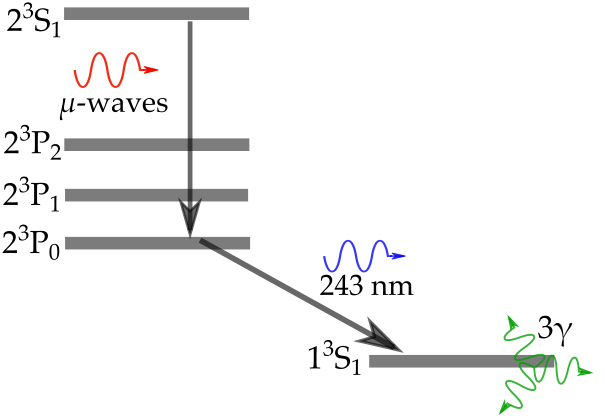
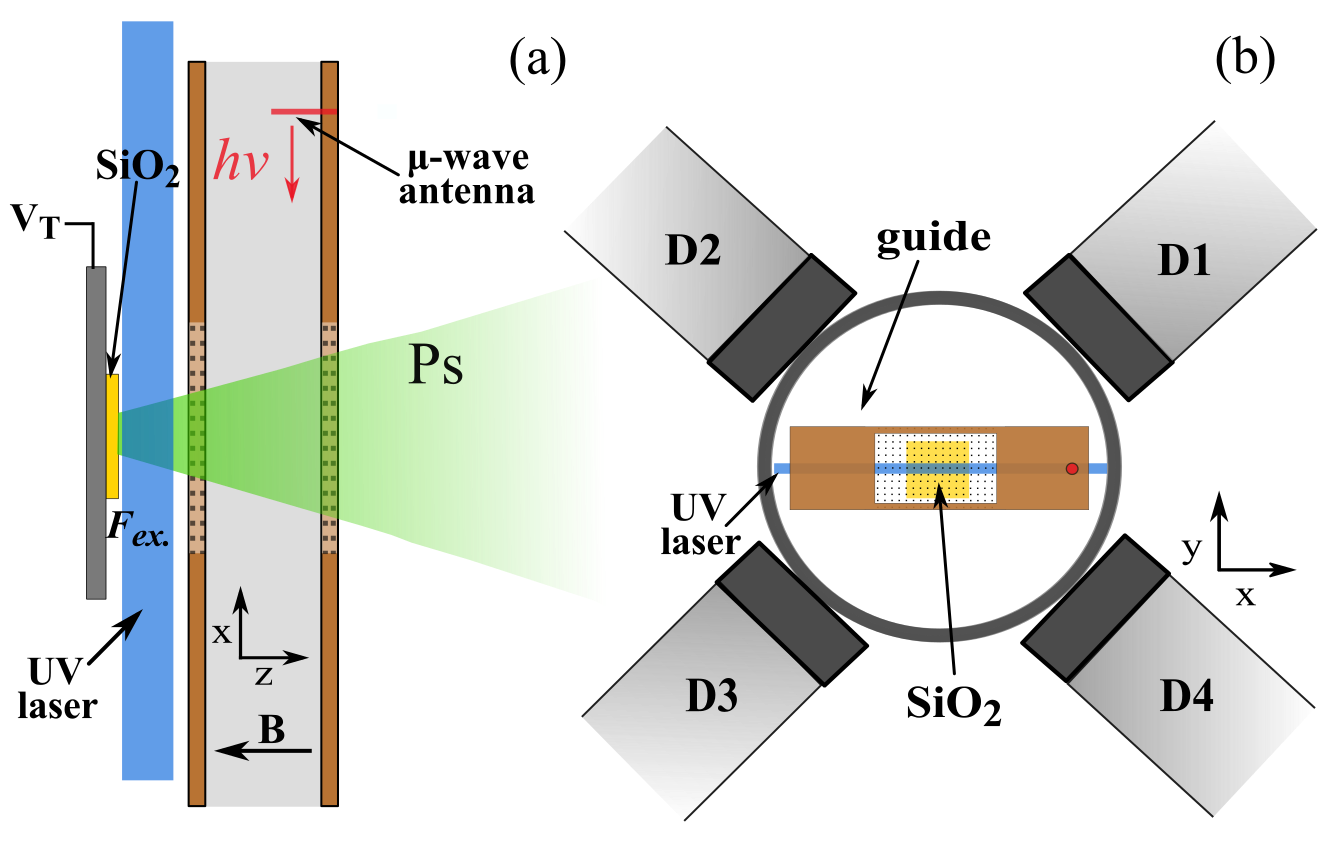
Recently we have measured the 2S-2P fine structure intervals of positronium [4]. There are three transitions within this branch and in this post, we’ll talk about the ν0 transition (23S1 – 23P0) which is resonant around 18 GHz. This transition, including the other two, is illustrated in figure 1. Initially, the Ps atoms (which are formed in the 1S state) have to be excited to the 2S state. This can be done in several ways (direct 1S-2S transition with one photon is not allowed), and we will cover our method in detail in another blog post soon. For now, let’s assume that the atoms are already in the 2S state. These atoms then fly into a waveguide where the microwaves drive them to the 2P state (via stimulated emission) as shown in figure 2. The atom then emits a 243 nm photon and drops down to the 1S state, where it will annihilate into gamma-rays after 142 ns (remember the lifetime of Ps in the ground state?). If nothing happens in the waveguide, the 23S1 state atom will annihilate after 1 μs.

BlogSchematic
Figure 2: (a) Target, laser, and waveguide schematic. (b) Placement of detectors, D1-D4, around the chamber.

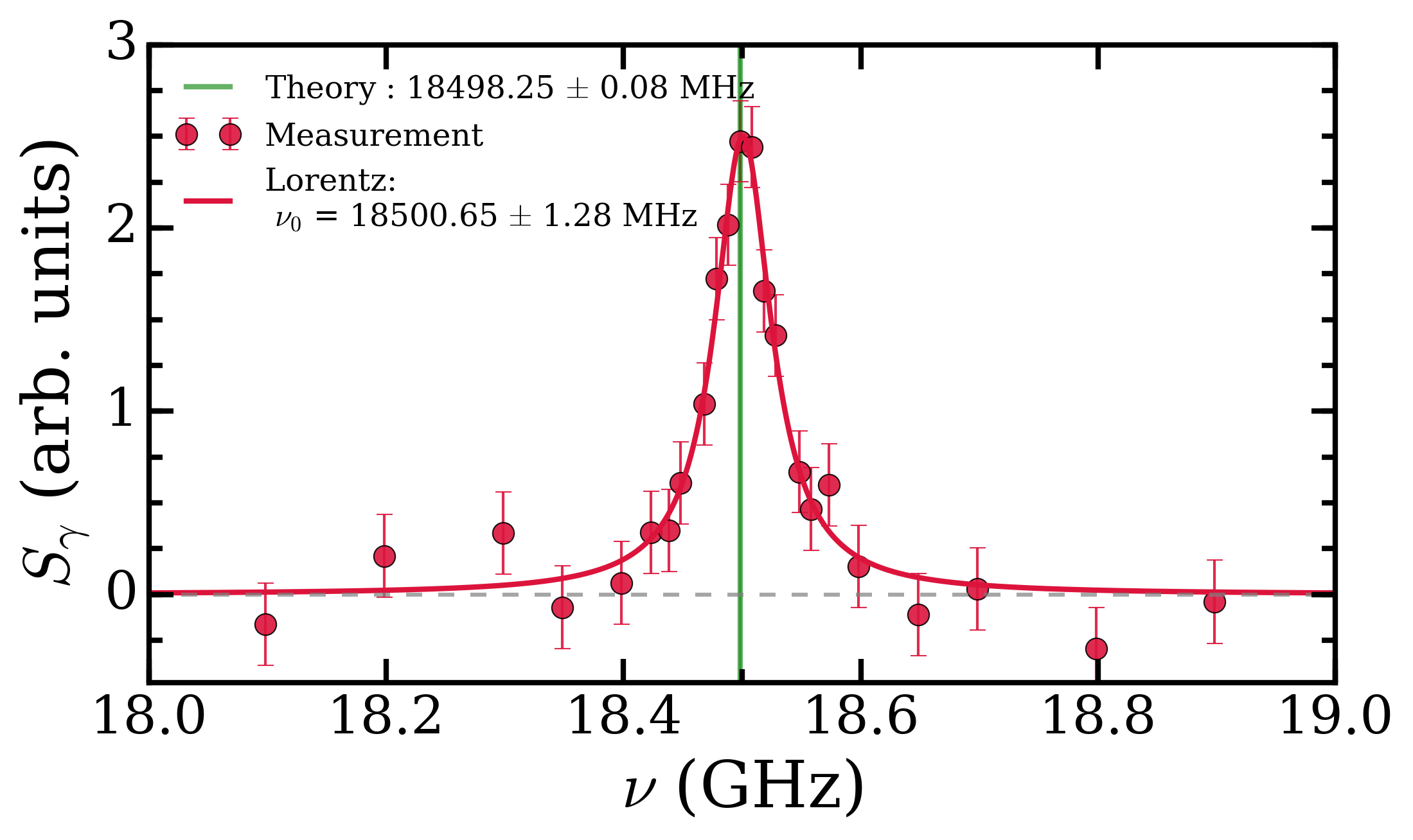
We placed gamma-ray detectors (D1-D4) around the target chamber, as shown in figure 2, to monitor the annihilation signal. The detector signal was then used to quantify the microwave radiation induced signal, Sγ. We scanned over a frequency range to generate a lineshape that describes the transition; the centre describes the resonance frequency and the width is due to the lifetime of the excited state. A Lorentzian function was fitted to extract this information and for the example shown in figure 3, the centroid and line width are 18500.65 MHz and 60 MHz respectively. The centroid is slightly off from theory because the lineshape was measured in a magnetic field which introduces Zeeman shift to the centroid. The measured width is 60 MHz, slightly wider than the expected 50 MHz, and is due to the time taken to travel through the waveguide.

23P0LineshapeBlog
Figure 3: Measured 23S1 – 23P0 transition lineshape with theoretical resonance frequency of 18498.25 MHz.

Similar lineshapes were measured over a range of magnetic fields in order to account for the Zeeman shift. These data are shown in figure 4. Extrapolating to zero with a quadratic function allows us to obtain the field free resonance frequency, free of Zeeman shifts. However, all of the measured points, including the extrapolated number, are offset from theoretical calculation (dashed curve) by about 3 MHz. There are a few systematic effects to consider and the largest of them is the Doppler shift arising from the laser and waveguide misalignment, which amounts to 215 kHz. Our result, compared with theory and previous measurements, is shown in figure 5 and disagrees with theory by 2.77 MHz (4.5 standard deviations). While the precision has improved by over a factor of 6, the disagreement with theory is significant.

Precision measurements can be vulnerable to interference effects and there are two main types of effects that can cause lineshape distortion and/or shifts in line centre. Whenever the radiation emitted from the excited state (2P state in our case) is monitored to generate the signal, the emitted radiation can interfere with the incident/driving radiation (microwaves in our case)[5]. This leads to shift in the resonance frequency, but we are not sensitive to this kind of effect as we monitor the gamma-rays instead of the 243 nm emitted radiation (figure 1). Another type of interference arises from the presence of neighbouring resonance states [6], such as the two other 2P states in the Ps fine structure. The further apart the states are, the lesser the interference effect is and we expect a shift of 200 kHz in our line shape. This is, however, over 10 times smaller than the observed shift, and therefore, cannot be the reason for the disagreement.

There are two more transitions in the fine structure we have measured and they reveal interesting new features which were not previously seen. These additional data will provide a broader picture that will help us explain the shift we see in this transition. We’ll discuss those results in the next blog post.


[1] Karshenboim, S.G., Precision Study of Positronium: Testing Bound State QED Theory. Int. J. Mod. Phys. A, 19 (2004)

[2] Rich, A., Recent Experimental Advances in Positronium Research. Rev. Mod. Phys., 53 (1981)

[3] Hagena, D., Ley, R., Weil, D., Werth, G., Arnold, W. and Schneider, H., Precise Measurement of n=2 Positronium Fine-Structure Intervals. Phys. Rev. Lett., 71 (1993)

[4] Gurung, L., Babij, T. J., Hogan, S. D. and Cassidy, D. B., Precision Microwave Spectroscopy of the n=2 Positronium Fine Structure . Phys. Rev. Lett., 125 (2020)

[5] Beyer, A., Maisenbacher, L., Matveev, A., Pohl, R., Khabarova, K., Grinin, A., Lamour, T., Yost, D.C., Ha ̈nsch, T.W., Kolachevsky, N. and Udem, T., The Rydberg Constant and Proton Size From Atomic Hydrogen. Science, 358 (2017)

[6] Horbatsch, M. and Hessels, E.A., Shifts From a Distant Neighboring Resonance. Phys. Rev. A, 82 (2010)